Sparkle Theatricals presents “Feed Your Head” – Graphic Design by Christina Vang
It has been a month of firsts for me, my first Festival, first live show featuring modern dance, First Shadow puppet show and now my first immersive theatrical experience. The production does not take place in a traditional performance space, but in what appears to be a business location in an out of the way mini strip mall. You will not be judged, given that it is Halloween, for wondering if you’ve been lured to this location never to be heard from again. I have come to appreciate nontraditional performances spaces, sometimes they are just the thing to create intimacy and connection as in the Church basement for Rogue Prince, or to create atmosphere such as The Southern Theater with it’s crumbling castle interior perfect for the TCHF. This space also was well utilized to create the impression it was after. The show runs about 1 hour, no intermission obviously.
Here is the set up of Feed Your Head, the audience are all new hires at the Best Butter Company and we have arrived for orientation. We are given name tags and either a blue or red pen to write your names with. Blue means you are ok with the actors touching you, Red means you prefer not to be touched. Don’t worry about going blue the most that will happen is a touch on the shoulder, normal day to day contact. Orientation which is led by Bunny played with super insincere enthusiasm thinly masking her judgement and disapproval by Clara Kennedy. We are led into a room where we watch the obligatory video presentation about the history of the Best Butter Company and a message from the current head of the family run company. If you’ve ever had to sit through one of those you will appreciate the humorous touches.
From there we begin a tour of the facility and meet some of the other employees. Quickly the whole thing goes from a silly spin on a new hire orientation to a variation on the Mad Hatters Tea party. There is the Accountant who gives a presentation on the companies financials which is really a magic show by slight of hand wizard Steven Paul Carlson. The other Employees are: Hatter played with the requisite anarchic bent by Dominic Rodgers, Harry played by Christine Pietz and Mousey played by Ella Dierberger. Each member of the cast commits to their characters and plays up the absurdities pulling smiles by their work even when they are not part of the imminent joke.
To tell anymore of what happens would be to give away the surprises and much of the fun is in the unexpected. The humor ranges from lounge act to Looney Tunes and it all lands perfectly. It may not be the scariest thing going this Halloween but there is more than a touch of madness at work here. Per the Companies website the show is appropriate for ages 12 and up. I can’t think of a more unique and fun activity for a family to do over the next three days then take in one of these shows. It’s fun, it’s not too long, it’s full of humor, a great introduction to kids that maybe haven’t been exposed to much in the way of theater. But also for older kids who are interested in theater it’s a great display of some wonderful creativity and spot on character work. Don’t get me wrong though, you don’t have to have kids, there wasn’t a single person under 20 in my group and I think it’s safe to say we all had a great time. The Show runs Oct. 31st thru Nov. 2nd Three times nightly 6:30, 8:00, and 9:30 for more info and to buy tickets click here https://www.feedyourhead.show/
This will likely be the last of my reviews from the TCHF. I’d love to catch the last three shows I need to see on Saturday, if my schedule will allow for it I will and be sure I’ll post reviews. This was my first experience with this festival and I strongly recommend that people get out and see the shows. Everyone of them still as at least one performance left, most two and some three. I have found something rewarding in each of the shows. As delighted as I was with the first five shows I reviewed I was blown away by this second batch. I expected more of the shows to be genuinely scary, most have not been, but they have been fascinating all the same. The one Play that actually delivered in spades on the scares was also my favorite of the Festival and the first up for this review and it is.
Frankenstein
Frankenstein by Dangerous Productions Photo by Dan Norman
Dangerous Productions’ Frankenstein by Tyler Olsen-Highness is not your father’s Frankenstein. This is a modern story told in a nonlinear fever dream, Mary Shelly’s book is referenced by the characters and they all have the names of characters from the book. Victor is still the creator of the horrors, but he is more of a sociopathic obsessive than a misguided genius. The cast is uniformly effective and intense. Much of the play is played in the dark with lighting effects and flashlights used to startle, misdirect and create uneasiness. The play progresses from creepy lighting effects to ever more startling moments. Our eyes temporary blinded by lights being pointed directly at us are not prepared for the movements of the characters. Frankenstein is also by far the bloodiest of the festival. There are some extremely effective moments of violence and gore. This is not the show to bring the tweens or younger too, but everyone else should be sure to make this the top of your “to see” list. Frankenstein puts the Horror in TCHF!
The Rule of Three
The Rule of Three by Four Humors Photo by Dan Norman
The Rule of Three is a trip-tech of an anthology of anthology shows. It’s not that scary but it’s still dead brilliant. Presented by Four Humors Theater and written by Matt Spring, who is also one of the three performers along with Ryan Lear and Brant Miller. The show presents three different stories each reminding me of a different anthology TV show. The first act plays like an episode of Black Mirror, it is set in the future and involves the evolution of Deepfake technology. The show makes extensive use of video footage is a very clever indication of the ways in which technology has become even more enmeshed in our society in the future. Smart and funny as it begins, it grows darker ending as a cautionary what if. The second act is entirely video, it is a pastiche of the 1990’s TV series Are you Afraid of the Dark? Even going so far as to replicate that series campfire set up. This Act is about as scary as one of those episodes but it makes up for a lack of frights by being hysterically funny. The final act is completely humorless and the darkest of the three. It tells the story of an group of settlers making the trek to the west coast who are stranded as winter sets in and have to do whatever they can to stay alive through the winter. It is told by jumping back and forth in time, revealing new pieces of information with each change in the timeline, slowly revealing what lengths they have resorted to. This act reminded me, as did the entire production in a way of a great British anthology show called Inside No. 9. For sheer entertainment The Rule of Three is the show to see.
AMP
Amp photo by Hunter Canning
Amp written and performed by Jody Christopherson is easily the most political and serious minded of the productions I’ve seen at the TCHF. Christopherson plays Mary Shelley and tells the story of the woman who created one of the most enduring mythologies of the last 200 (ok actually 201 years). The productions main thrust is not the story of Frankenstein’s creation but of the creator herself. We learn a tremendous amount about Shelley during the course of the play a woman very much ahead of her time, a feminist from a patriarchal era. Brought up to be a free thinker and follow her heart, she was let down by a society that did not give women the same rights as men or allow them the same humanity even. Throughout her story we see details that will work their way into her immortal story. The script and performance have been honed to a T. There does not seem to be any padding, every line of the script either contributes essential details or helps to convey the emotions of this fiery woman. The performance of Christopherson is passionate and intense, being the only performer she has a lot to carry a lot of information to convey while still informing us of Shelley’s emotional states as well. There are horrific elements on the production, but to my mind this is a “me too” story, timely and important as we look back all those years ago and see that many of those same shadows still hang over us today. More of an think piece than an entertainment, but that is what is so fascinating about this festival, the variety of what is presented.
…And What Alice Found There
…And What Alice Found There by The Winding Sheet Outfit Photo by Dan Norman
The Winding Sheet Outfit’s production of …And What Alice Found There explores the relationship between Charles Dodgson aka Lewis Carroll and Alice Pleasance Liddell, the basis for Alice in Wonderland and Through the Looking Glass? The question mark reflects the nature of the show which asks questions but doesn’t provide answers. Does that sound like a cheat? Well it isn’t, because there are no answers to the questions it raises. The production is seemingly a meeting between Dodgson and Alice when she is older, but the meeting seems to be taking place in Wonderland and Alice is accompanied by the denizens of that place…or other children who were friends of Dodgsons. While never actually scary in itself this show finds it’s horror in the possibilities it suggests, and they are much more disturbing than what my son used to refer to as poppy outies. There is a dreamlike quality to much of the proceedings with an edge of creepiness on two fronts. The relationship being examined has sinister overtones but is discussed with an almost whimsical tone. The children at times amusing can also be creepy such as when they parade about wearing masks of animals or when their silliness dips into mania. The production makes great use of silhouettes to create visuals illustrating ideas such as a poetic passage from a book. The sound design is also very effective in amplifying the discordant tones and suggestions. Creative use of various instruments for creating these sounds like using a violin bow on a metal bowl to create a sound that seems almost normal but not quite right, just as Dodgson’s relationship with Alice comes off. The point is to present this unknowable relationship and question it, while essentially admitting that we don’t know. It seems odd, and if it were happening today there would probably be an investigation…but we don’t really know.
you can find the schedule for all shows and purchase tickets at http://www.tchorrorfestival.com/ . The festival runs through Sunday Nov. 3rd. The wonderful thing about covering this festival has been to see the variety of work. Everything from truly scary stories to shadow puppets and science fiction. Also the creative ways in which the artists have found to share their ideas. This festival reminds us of all the talent and creativity out there and theaters ability to bring those things together to entertain, teach and yes, frighten us.
As you may remember from my feature preview of the Twin Cities Horror Festival’s (TCHF) 8th season there are basically 13 one hourish shows rotating throughout the festival. I am scheduled at this point to take in 9 of the shows, after today I’m going to try and get to three of the others if I can. If that works out the only show I will not have been able to fit in is the Horror Show Hot Dog, which are showcases for horror short films. My first love was film, so it was hard to pass those up, but a man has to sleep, eat, and write. Rather than write 5 separate reviews for today’s shows and risk some of them not getting seen or lost in an avalanche of posts, I’ll be writing one review with all 5 shows and another review with the 3 scheduled for tomorrow and the 1 scheduled for Tuesday. Do not adjust your computer screens, the format below, while not the usual, is correct.
This was my first visit to the Southern Theater in Minneapolis and I have to say I really like this theater. It is perfect for TCHF, inside the performance space it has the look of a haunted castle. They have a nice selection of beverages (including Lemonade) and snacks for sale in the lobby. One word of warning before indulging into too many local brews or lemonades, the mens bathroom urinal is broken, so there is one stall available. As anyone who goes to the theater often knows Bathrooms are always in short supply, even more so here. If you need to go between shows, hustle out of the theater and get in line, or if you are having dinner at a nearby restaurant, go there before heading over. Two fun additional sidelines on the second level they have Living Embalming Sessions by Funerals for Life, where you get a death certificate and a Polaroid picture of yourself, after they have embalmed you of course. There is also a table selling merchandise such as Beanies, Hoodies, T-shirts, Leggings, purses and even soaps. There were some very tempting items and I shouldn’t be surprised if I head home one of these nights with a t-shirt or a Beanie.
Feminine Inhuman
Feminine Inhuman by Erin Sheppard Presents/Monster Science Photo by Dan Norman
The first show of the day was Feminine Inhuman which takes the form of a lecture by Reverend Matt about female monsters in folktales and mythologies throughout the world. Reverend Matt’s lecture is about seven different creatures: the Acheri, Qalupalik, Encantado, Banshee. Kuchisake-Onna, Harpy, and the Nightmare. The lectures are humorous and well delivered if a bit rushed, likely due to time constraints, by the writer of the piece Matthew Kessen. Each monster’s story is then accompanied by a dance sequence. This seems like an odd marriage, a humorous fo-lecture combined with dance sequences but it really works well. The dancing is top-notch, only in the first sequence did it seem like the synchronization was a bit off between the Acheri and her Shadow at times. This was one of my favorite productions of the day.
Geminae
Geminae by Oncoming Productions. Photo by Alex Wohlhueter.
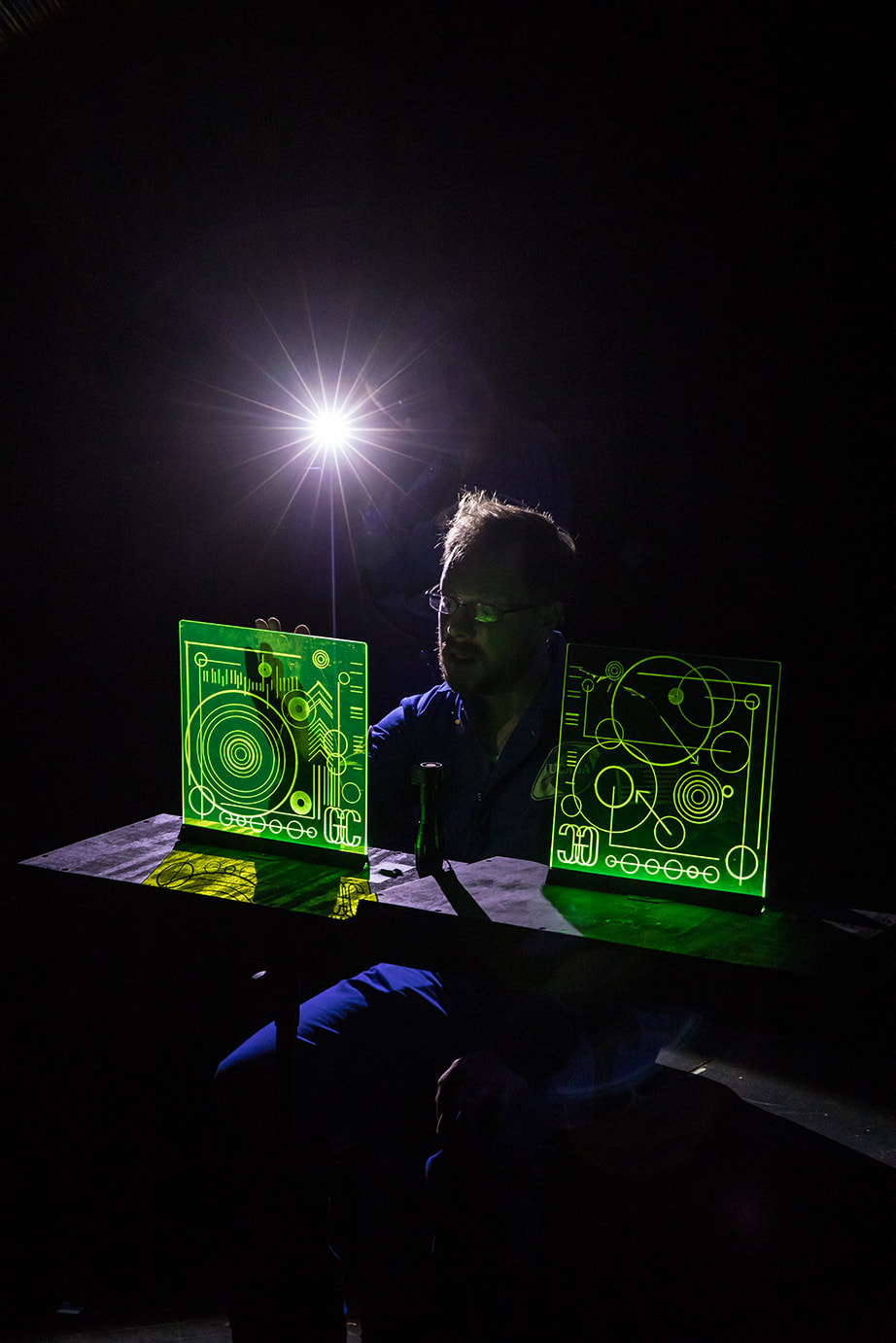
The second show of the day Geminae was a science fiction piece by Becky Wilkinson Hauser. It concerns an astronaut in orbit above earth who is losing oxygen and the mission control team who are trying to figure out how to save her. This shows highlights were the production design and performances. The astronaut Cassie played by Leslie Vincent is shown floating through space to check different areas of the ship from the outside. This is accomplished by the actress being supported and carried by Rob Ward who is listed in the program as The Void. This was a very creative and fun way to create the illusion of weightlessness. Dressed all in black so that he mostly blends into the background, I thought it a poor choice that he did not wear a black mask and gloves as that would have completed the illusion more effectively. But later The Void takes on another role, which perhaps explains that costume choice. On the other hand that other role, is also the weak point of the play. It’s unclear what that role is and the play ends without really explaining what The Void is. It would have been better to have Ward simply function as the tool for creating the illusion of weightlessness and find a more understandable resolution to the play. I wanted to give shout outs here to three actors that created very real feeling performances, Sean Dillon, Erik Nielsen and Gurayn Sylte. This play contained the best acting of the day, with those three being the standouts.
Charcoal Moon
Charcoal Moon by Rogues Gallery Arts Photo by Dan Norman
Third up was like the second show on a science fiction double feature. Charcoal Moon tells the story of two spaceships who have spent 6 years to reach a moon of a dwarf planet in our solar system to extract a mineral that can change the world. Something goes very wrong though and the ships crews find themselves at odds with each other. This is almost the reverse of Geminae. Whereas that show used a very low tech tool to create the illusion of zero gravity, this show relied heavily on video footage of messages between earth and the spaceships to illustrates it’s science, but both worked well with their stories. Their strengths and weaknesses were also swapped. Charcoal Moon had a much more satisfying script but the actors were not able to bring the same depth and realism to their roles. I think these contrasts reflect the differences in the plays themselves, whereas Geminae is more of a drama, Charcoal Moon is more of an action adventure piece. Charcoal Moon was written and directed by Duck Washington
Incarnate
Incarnate by Special When Lit Photo by Dan Norman
Incarnate by Nissa Nordland Morgan was the best show of the day. From the moment we were let into the theater the discomfort began. They asked us to write our names on a piece of paper and put it in the basket to be considered for a part in the harvest. Everyone knows this is code for pulling you up on stage to be a part of the show. After that while you sit in your seats waiting for the show to start, people come around and thank you for coming and being a part of the Oasis. You never really get to relax from that point on. When the show starts you realize you are at a somewhat christian, somewhat pagan service. This is the show that gives Geminae a run for it’s money in the acting category. The standout here is Lauren Anderson who plays Marigold, the charismatic Herald of The Oasis which is basically a cult led by her and Caretaker Dan. Adding to the discomfort for me personally was the fact that within the schedules handed out when the doors opened was a program for the Oasis service. I didn’t take one as I didn’t realize there was a program inside the Festival schedule, which I already had a copy of. So the entire service I had to stand there pretending I knew what to say when it came time for the congregation to join it. I don’t want to give anything away but trust me this is not a show for the wee ones. There is a scene of nudity that seems odd and unnecessary, but that is really the only misstep in a powerful play, and it’s a minor one.
Bug Girl
Bug Girl by LIZ howls Photo by Dan Norman
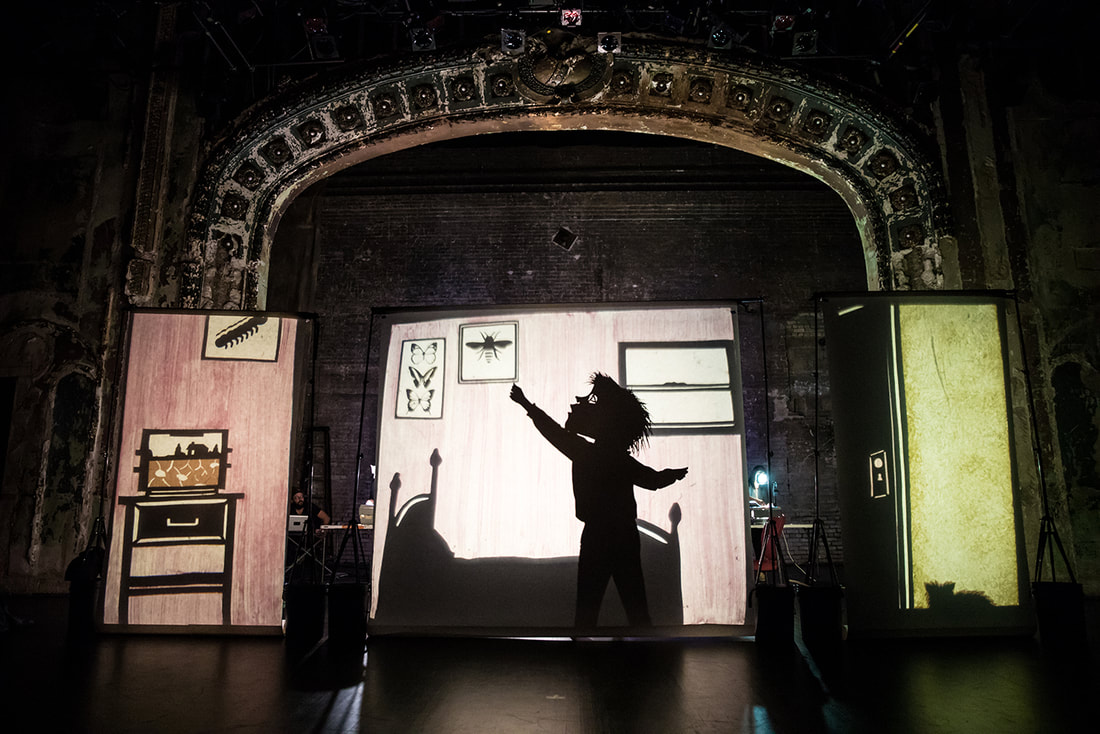
Bug Girl was the final show and lasted about 30 minutes. This was the most unusual production as it was a shadow puppet performance. I am not very familiar with Shadow puppetry and there were some really interesting elements to the show. It is a performance style that incorporates puppets and drawings with live action movement creating in effect a cartoon that is performed live. There are illustrations projected in coordination with other elements using overhead projectors onto three panels. There is a live performer wearing a mask that appears on the screens in silhouette and handheld puppets that are moved across the overhead projectors. I liked the technique quite a bit, there were some very striking visuals. The one issue I had was that it seemed to rest on that too much. The show established it’s visuals and then didn’t do much to raise the bar. It was the shortest show of the day but also the one that felt a bit long. The visuals went from striking to repetitive, once the style had been established very few new elements were added. It seems like a style of story telling where you should be figuring out ways to keep wowing the viewer with new techniques. Bug Girl is the creation of Liz Howls.
Tickets for the TCHF which runs through Sunday November 3rd as well as synopsis and content ratings for the shows can be found at http://www.tchorrorfestival.com/ .
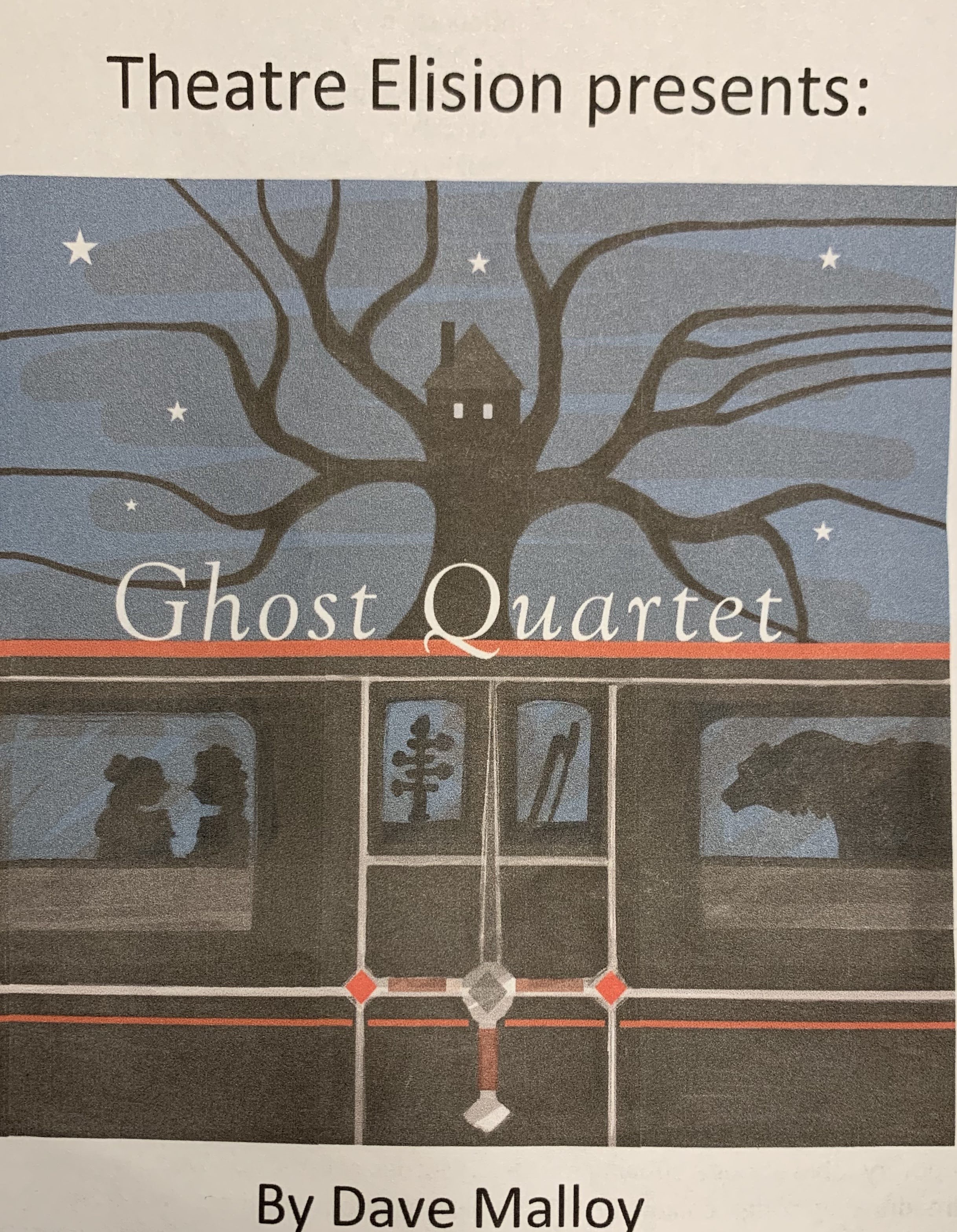
The Elision Playhouse in Crystal is a new performance theatre that opened in 2019 as a home for Theatre Elision and other theatre companies. There are two spaces a theatre and a cabaret. Ghost Quartet was performed in the cabaret setting which I assume doubles as the lobby for most shows. They have the usual concessions and bar, where you can get soft drinks, wine and beer. There were tables and chairs set up surrounding the stage area which was the center of the room. This like the Hollow which I reviewed earlier in the month is billed as a concept album, but whereas that production used dance to enhance the music, this show used snippets of dialogue. The Program notes
“We advise our audience members who are seeing this for the first time to not try to understand what’s going on (because it will make little sense). Just enjoy the music and experience that is Ghost Quartet.”
Theatre Elision Ghost Quartet program
Riiiiiiight. Well that certainly is good advice, because very little of it made sense and yet it was too specific to welcome the audience to bring it’s own interpretation.
The good news is that this is a talented cast, the four performers Kellen McMillen, Quinn Shadko, Tristen Sima, and Christine Wade are all talented musicians and singers. I found Shadko and Wade in particular to have powerful vocal tools and acting skills. They are accompanied by the music Director /Pianist Harrison Wade. Let me be crystal (bun intended) clear, the musicians and vocalists do a superb job. They also have a solid presence on stage and ably perform the dialogue and acted portions. There are several moments of levity within those interludes that almost assist us to find our footing in the show as a whole. But not quite.
I suspect I missed something, perhaps if I were not “seeing this for the first time” I would have gotten more out of it. But I cannot honestly imagine sitting down to the show a second time. Maybe it’s not my type of music. Maybe I just need a plot if you are going to have dialogue and be seeming to tell multiple disjointed and unconnected stories, except they all seem to be disjointed and unconnected within each story. I wanted to like this production I really did. I thought the description of the music sounded right up my alley. But it just didn’t connect. There are a couple of songs I enjoyed, “Starchild” and “Hero”, though don’t ask me now what they were about. A quick wikipedia search shows there is a very lengthy synopsis, which I have chosen not to read. This is a case where I feel like the show itself either speaks to you or it doesn’t. Perhaps if I’d tracked down one of the recordings and familiarized myself with the songs it would have been a different experience. There was also an unfortunate mic issue that persisted through the second half of the show that didn’t help things. That is the sort of thing there just isn’t really anything you can do about during the show. The actors must simply muster on which they gamely did.
There were a couple of other quirks in the show. first they handed out shots of whiskey to those over 21 and who cleared ahead of time that they would welcome it. I’m not sure why that was needed. I mean, it doesn’t hurt to offer free drinks to the audience and there were mentions of whiskey in the show, but it just seemed odd and unnecessary. The second was the handing out of percussion instruments to members of the audience. This was done twice. The first time I was praying to be spared, and thankfully I was. I looked around at my fellow audience members , some of whom seemed to enjoy it. One Patron seated near me was given a rain stick to accompany the music with. I may be mistaken but they seemed to be having the reaction I would have had, which is, what the F*#@ am I supposed to do with a rainstick? this experiment in audience participation didn’t seem to work, as I can not remember a single thing about that song. The second attempt at press ganging into percussion service I was not able to avoid. Luckily, I was not given a toothpick and cheese grater and expected to contribute anything meaningful. I was thankfully given a Maraca. though rusty, the 11 years of Maraca lessons I took from Mrs. Johnson down the street growing up came back to me. The extraordinary thing is, that this attempt at audience participation was the single strongest moment of the show, once everyone was playing, the cast walked out of the room and we kept playing until we naturally finished. It ended the show on a very high note and a feeling of connection that was in contrast to the alienation that proceeded it. It really was a great ending, but it was too late to save the show for this reviewer.
Again, The performers were great, they sang well, I just didn’t connect with what they were singing. If I saw this cast was performing another show, I’d be there in a heartbeat as their talent is clear. For me the let down was the writer Dave Malloy. I know he is a Tony Nominated artist so a talented writer of music no doubt. But this just seemed impenetrable to me. Now that I have finished writing my review I’ve gone a looked around a bit and I find that some local reviewers I admire such as Cherry and Spoon and Twin Cities Stages have given praise to the show in past productions. So If you are familiar with the show or the music then by all means check it out, it runs thru Oct 31st. Tickets can be purchased on their website https://www.elisionproductions.com/gq19
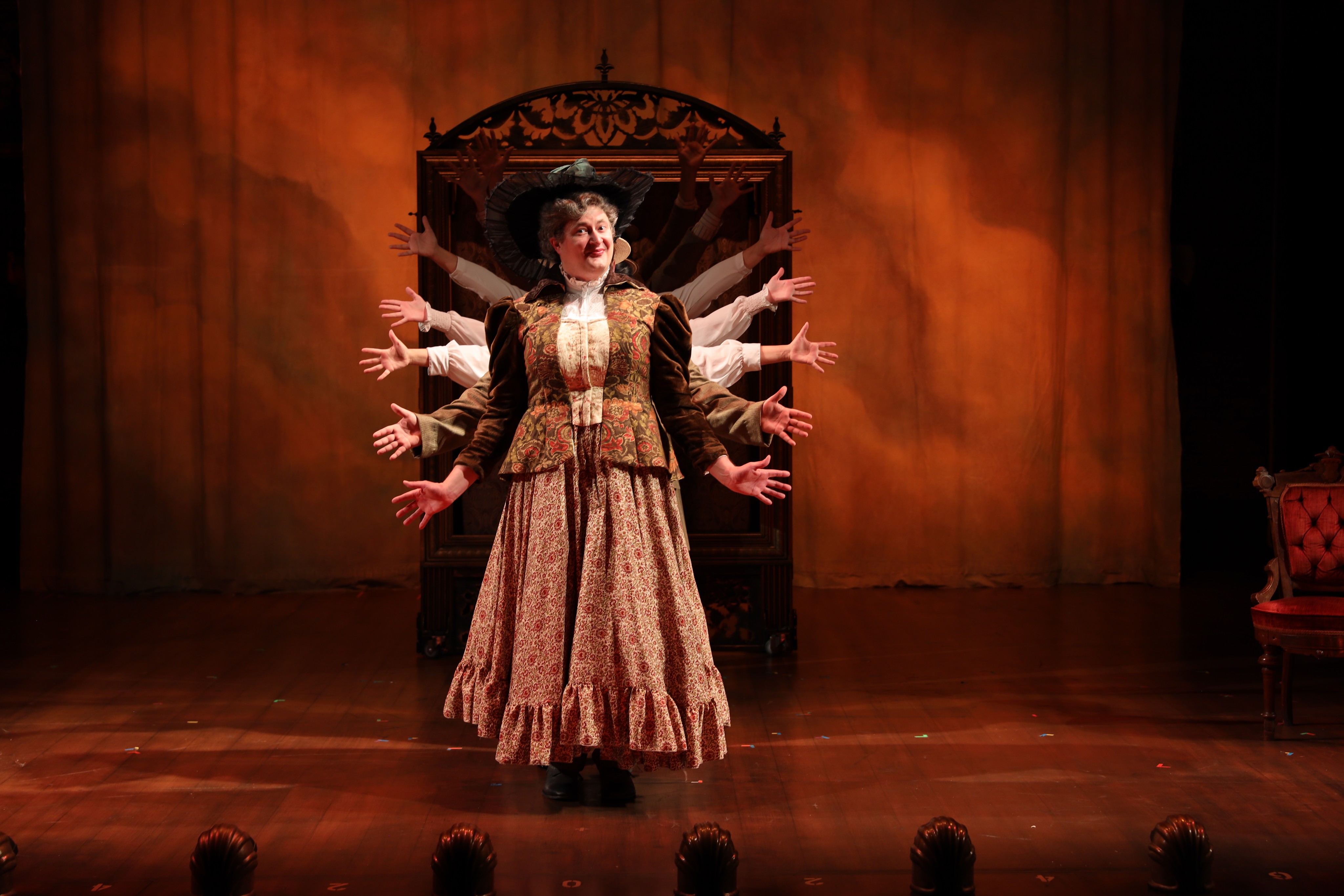
David Beukema as the entire D’Ysquith Family. (photo Old Log Theatre)
This was not my first visit to The Old Log Theatre, I have been going there annually for close to 20 years. It was however my first non-kid-centric production and I wasn’t sure what to expect. The yearly Christmas shows that I had been attending with some combination of children or grandchild were always fun affairs if a little underwhelming. Though truth be told, several of the productions in the last few years seemed to have raised the bar a bit. Well, I was not disappointed in the quality of the production or the cast. A Gentleman’s Guide to Love & Murder as a show is a superior musical comedy, Book and Lyrics by Robert L. Freedman and Music and Lyrics by Steven Lutvak, the show won 4 Tony awards in 2014 including Best Musical and Best Book. Based on the 1907 novel Israel Rank: The Autobiography of a criminal by Roy Horniman. This novel was also the basis for the 1949 British Film from the Ealing Studios Kind Hearts and Coronets, which I am very fond of. Clearly taking a queue from that film in which Alec Guinness played nine separate members of an upper class family, A Gentleman’s Guide to Love & Murder also casts one actor, David Beukema, in just as many roles.
The musical begins with a warning to the audience that it is about murder and suggests that if you are of a weaker constitution you might want to leave before it starts. We then meet Monty Navarro who is writing his memoirs in prison while he awaits the ruling in his murder trial. The rest is basically a flashback. Beginning when Monty, after returning from the funeral of his mother is informed by an old friend of hers that he is actually a member of the wealthy D’Ysquith family. In fact, it turns out he is Ninth in line to be the Earl of Highhurst. His mother was disinherited and forever rejected by the family for eloping with his father whom she loved despite being beneath her in the families eyes. After his father died when he was seven, his mother and he scraped by as best they could. Letters he finds confirms that she tried repeatedly to reach out to her family for help, all of which were returned without assistance. When his attempts to reach out to his newly discovered family are rebuked, and faced with the realization that the woman he loves, Sibella will never marry him as he is not rich or have any real prospects, he hits upon the idea of shortening the line of succession, by killing off the members ahead of him. The rest of the show concerns itself with the murders of the eight family members ahead of him in line for the Earldom. Adding yet another layer is his engagement to Phoebe, the Widow of one of his earlier victims, which occurs with Sibella, now his married mistress in the other room.
Max Wojtanowicz who plays Monty is well cast. The role requires a performer that can win over the audience despite committing what, when you think about it, are some truly horrible acts. He has a good singing voice and the perfect body language to convey the almost straight man reactions to the D’Ysquith family. Speaking of the D’Ysquith family, David Beukema absolutely nails each of his nine roles. Assisted by Costumes, he finds ways to make each member of the family unique and amusing in their own ways. This is a tour-de-force of comic acting, each character distinct. One’s mind boggles at the speed of costume changes that must be occurring back stage. One of my favorite songs in the show was a duet between Wojtanowicz and Beukema “Better With a Man” It perfectly blends the wit and humor of the lyrics with the comic blocking of the action, keying into the performers reactions to each other. Both actresses Emily Scinto (Sibella) and Elizabeth Hawkinson (Phoebe) are lovely in their parts with beautiful singing voices. They share a scene with Wojtanowicz involving a set of doors and the song “I’ve Decided to Marry You” that involves split second timing on the part of all three performers which is another highlight of the show. One other performer that really caught my attention was Suzie Juul in her role of Lady Eugenia, the interaction between that character and Beukema as her husband Lord Adalbert are fantastic in their caustic mutual loathing.
The show as directed by Eric Morris is fast paced with not a swing wasted as we chop our way through the D’Ysquith family tree. The set is changed by the drawing of curtains and the rolling on and off of various pieces. All of the frequent transitions are handled smoothly, moving between scenes fluidly and without drawing attention to them. We are never left at a loss for where a scene is taking place or have the feeling there is more on stage than there needs to be. It’s a very clean and effective design. There were some interesting uses of fabric and lighting to convey scenes that could have been challenging. When a character falls to his death, his fall and landing are suggesting mainly through lighting. When a couple falls through the ice on a lake we see them struggling underwater silhouetted behind a sheet. Clever ways in which to capture these visual moments. There are also some very clever costume and prop designs, a rifle with a ever elongating barrel, a bee keepers hat, and the head of a Major are just a few examples of the inventive work being done in those departments.
This is a show full humor, filled with witty and catchy songs. The Old Log has mounted an impressive production. Including a masterclass in comic acting from David Beukema in nine separate roles and Max Wojtanowicz as the perfect sympathetic murderer. Perfectly complimenting each other Beukema creating the characters and Wojtanowicz reacting to them. You are not going to beat this for entertainment, it’s about some dark themes but it’s appropriate for teens and Grandma alike. Tickets can be purchased at the Old Log’s website http://oldlog.com/ The show runs through February 15 2020. Plenty of time to take it in, but don’t let this one slip your mind. Go early in it’s run, you may just want to take it in again before it closes.
Emily Scinto, Max Wojtanowicz and Elizabeth Hawkinson (Photo Old Log Theatre)David Beukema (Photo Old Log Theatre) Emily Scinto and Max Wojtanowicz (Photo Old Log Theatre)
I saw Violent Delights at the Off-Leash Art Box in South Minneapolis, but that is not the only place to see it. It is being performed through November 2nd as “pop-up” performances in various locations in Minneapolis. Visit the website at https://www.theseviolentdelights.org/ to find a date and location that fits your schedule. I was curious about this choice and learned from their website that “We want to get theatre off the stage and into our neighborhoods”. That’s obviously not a viable option for all shows, but it suits this show perfectly, which has no sets, no props, just eight actors, a script and minimal lighting which I suspect is easily adaptable to each performance space.
The show was conceived over 10 years ago by it’s creator Penelope Parsons-Lord after attending a performance of A Midsummer Night’s Dream where she was dismayed at the audiences response to a threat of rape between two characters. What grew out of that exploration of why the show played that moment for laughs and why audiences might react in that way was Violent Delights. Parsons-Lord has taken the scenes of violence, sexual and otherwise from the works of Shakespeare and presented them in a way that draws attention to those acts and makes us look at them for what they are as opposed to being lost in the flow of a play, where some of the less palatable aspects can be downplayed. Instead she holds the scenes up, strips them of anything but the language and the interpretation of the actors, creating a more impactful understanding of the text.
The scenes are not presented in some mishmash attempt at a narrative, instead she sticks to the more familiar works, Hamlet, Othello, Romeo and Juliet, Richard III, MacBeth, Titus Andronicus, Much Ado About Nothing, and A Midsummer Night’s Dream so that she can just present the scenes and not worry about context. To set the audience up for the evening, the actors are already on stage when you enter the theatre, they then proceed to stand there for 15 minutes staring straight ahead until the performance starts. Right away we know this is going to be a different evening than what we generally get at the theatre. When they start speaking, they begin monologues one at a time then overlapping so that one cannot really follow any one performers speech. This again reinforces we will be seeing something different and also comments on the reputation that Shakespeare sometimes has for being incomprehensible to the average person. The cast then proceeds to act out the various scenes deftly speaking the language so that meaning is clear. This should reassure any audience member that they are not going to be lost. This is basically Shakespeare: The Naughty Bits shows us how modern it can feel and how the language is not beyond our grasp at all.
The most clever aspect of the show is the repetition of a few scenes. One is from Hamlet, basically they act out the “Get thee to a Nunnery” scene between Hamlet and his mother in her bedchamber. Later, they revisit the scenes, but play them at the same time, Hamlet turning between Ophelia and Gertrude, creating a new and dynamic scene. The even more telling repetition comes in the scene between Helena and Demetrius from A Midsummer Night’s Dream that inspired Violent Delights. This scene is replayed throughout the evening at least 4 times, each time in a new way. The first time the scene is played, we must imagine that performance 10 years ago, as comedy. The final recitation is played very dark and sinister. This illustrates the ways in which interpretation and how an actor plays a scene can dramatically alter it’s meaning. The contrast is startling.
Whether you’re a fan of Shakespeare or afraid, this show is equally for you. If a fan, you will find new meanings in the ways in which the text is brought to life. If afraid, you’ll learn how accessible it can be in the right hands. The cast are all uniformly gifted at conveying Shakespeare’s language. The show is surprisingly physical, and again the cast is all game and totally committed. It’s an intimate and exhilarating night in the theatre. The location I attended is their most traditional; however, I’d be very interested in seeing it in another location sometime. Get thee to a pop-up performance.
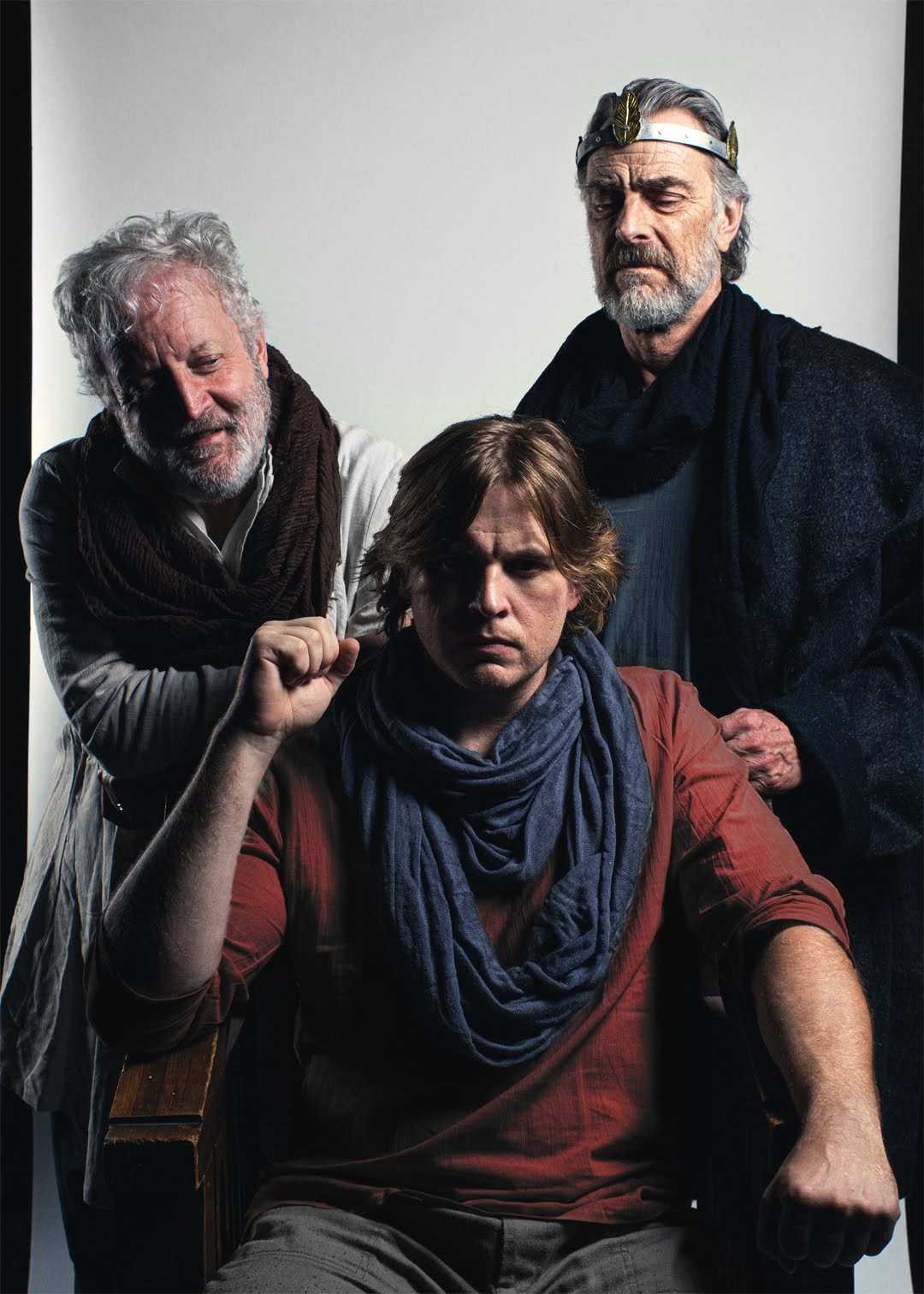
Gary Briggle, James Napoleon Stone and Bruce Bohne. Photo by Craig James Hostetler
Rogue Prince: Henry IV parts 1 and 2 is Theatre Coup d’Etat’s condensed adaption of William Shakespeare’s plays Henry IV parts I and II. The production is being staged at Calvary Baptist Church in South Minneapolis and the space is well suited for the job. As one enters the church basement there is a ticket and drinks counter where you can purchase, water, Ale’s or a Hot Buttered Rum, which I thought was a nice touch. Seating is general admission, there is a large open at one end rectangle of chairs running from the stage to the back of the room which forms the boundaries of the performance space. In the center of the this there are tables, chairs and benches which along with the stage area is where the actors will perform. I’d recommend sitting centered along one of the sides, I sat along the back and while for the most part I could see everything there was one point in which an actor stood with his back too me blocking my view of the action on and in front of the stage. Overall I enjoyed the immediacy brought to the play by sitting in such close proximity to the actors.
Rogue Prince focuses it’s plot on the relationship between Prince Hal, the future King Henry V and Sir John Falstaff: a fat, lying, cowardly yet undeniably charming Knight. The portions of Shakespeare’s plays dealing with aspects other than this primary relationship are present only in as much as they are needed to give that story context. King Henry IV must put down a rebellion, we are given the motivations and details of the rebellion so that when Prince Hal and Falstaff go off to battle we understand why. We are also given scenes with Henry IV expressing his displeasure with Prince Hal’s use of his time and the company he is keeping. When we see what that entails, robbery, drinking and other low activities we can understand his fathers frustration. Throughout the evening we see Hal grow from a wild young man to a King who is ready to take up the responsibilities of that position and turn his back on his wild ways and the rapscallion who taught him them. The Script which as adapted by Gary Briggle is influenced heavily by Orson Welles script for his film Chimes at Midnight, which likewise focuses on the relationship between Falstaff and Prince Hal. Briggle who along with co-directing the play with Wendy Lehr also stars as Sir John Falstaff. Like Welles’s film was to him, this play is clearly a passion project for Briggle.
Gary Briggle while not quite as large in height or girth as we are used to seeing our Falstaff’s he easily obscures that fact with his command of the language and understanding of the role. Briggle handily portrays all of the characteristics of Falstaff: his charm, his wit, his ridiculousness, his weariness and finally the heartbreak and betrayal when Hal turns him away. He covers all of these aspects and more and blends them seamlessly into a cohesive character that feels like more than the sum of his parts. He has a scene with Doll Tearsheet, a Prostitute whom he has an ongoing relationship played excellently by Anna Leverett. The purpose of the scene plot wise is for Hal to overhear Falstaff speaking ill of him. I found the interactions between Flastaff and Tearsheet in this scene to be an unexpected moment of quiet, like Falstaff taking a breathe and a break from being larger-than-life. This is Briggle’s show and he carries it nicely. The other standout is James Napoleon Stone as Prince Hal, who convincingly transforms from the aimless prank playing youth to a properly commanding king. All of the cast speak the lines like they understand them and that makes it very easy for us to adapt to Shakespeare’s language. The audience is never left wondering what is happening, And that is something the cast should be congratulated for.
The set in minimal, basically some tables and chairs and a bed, but it is all that is needed to convey the settings. Costuming was a little underwhelming, some looked like leftovers from the Renaissance Festival, Bardolf’s costume in particular struck me this way. But others conveyed what was needed effectively enough. I found King Henry’s costumes worked especially well, and costumes helped to emphasize the transformation of Hal as well. One issue that did arise, there are by my count 30 roles, played by 11 actors. For the most part I had little trouble keeping straight what characters were on stage with the exception of Damian Leverett’s characters Prince John of Lancaster and Poins. This is no mark against Leverett’s performances. This strikes me as a character that either has to be played by two different actors or there needs to be a more pronounced costume change. Both characters look the same and hang around Prince Hal at different times, and it’s very easy to assume they are the same person but have different names as do other characters i.e Hal/Harry/Henry and Sir John/Jack Falstaff.
Rogue Prince: Henry IV parts 1 and II runs through October 26th at Calvary Baptist Church in South Minneapolis tickets can be purchased at www.theatrecoupdetat.com.










You must be logged in to post a comment.