
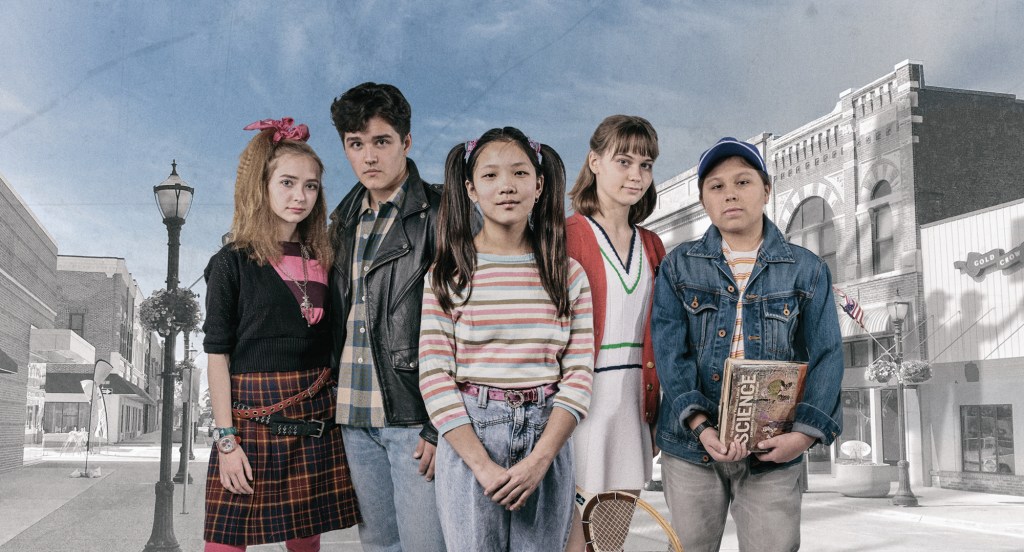
It has been well over a decade since I’ve been to a performance at The Children’s Theatre Company and it was nice to be back. Spamtown, USA is a more serious minded show than what I would generally expect from CTC, which is why the production is recommended for ages 9 and up. Spamtown, USA deals with the P-9 strike at Hormel in Austin MN in 1985 to 1986. It deals with this serious historical event in a way that will not bore children but will teach them with humor, just enough information, and the use of characters we come to care about. It expertly shows us the event through the eyes of the young people of Austin MN. How they see the adults and how they see each other through the eyes of their parents situations. I don’t think there is a better way to share this event with young people than what Philip Dawkins’ has accomplished with his play.
He tackles the elephant in the room right away, which is the complex reasons for the strike and the points of view of the two sides. Having the adults substitute what a real adult would say with lines like “long word” “blah blah blah” “adult Words” he tells us this isn’t about the details of the event, they don’t matter. It’s not about who was right or wrong, it’s about the effect it had on the people and particularly the kids. It also places the adults in the audience back into childhood, that is literally what we heard when our parents were talking about their jobs with each other at dinner. If that seems wrong, you have to remember this was set back in the 1980’s before children became the center of families. The world was a different place back then, many things will seem strange when compared to today. You may notice a lack of anxiety attacks despite some pretty rough things happening, that again was normal in the 1980’s. It’s a brilliant technique though that reminds adults, while also acknowledging to kids, that the play understands their angle on things.
The play follows 5 kids and 6 adults as they go through the events of the strike. Amy and Travis are the star crossed high school lovers in the play, his Dad works in the plant and her Dad is Management. When the strike begins they feel the pressures to stop seeing each other and they see each others families through the lens of what they hear their own parents say. Amy has a younger sister Carol who will be someone who can ask clarifying questions to help younger audience members understand some of the details, like what a Scab is during a strike. Travis’ sister Jude is the one through whom we see the cost of the parents being so focused on the strike. She doesn’t have clean clothes or a parent there to root her on in the big tennis tournament. She shows us that in their fight for what they want, the parents forgot they were also parents, not just strikers. The final kid is Jude’s cousin and best friend Scott. He wants to be an astronaut so he can get out of Austin MN. His father becomes a scab so that his family will be able to eat. This causes friction within the two related families, and it’s through this family that we see some of the worst elements of the strike, the intimidation and destruction. By the end there was a genuine tear in my eye for several different threads in this story. It really is an amazing example of a serious play for young people that they can understand, identify with, and also be entertained by. The children learn by watching what has happened, watching their parents and watching their own relationships. They learn hopefully a different way for their futures.
The Director of the play Will Davis has done a wonderful job of keeping the story moving. The set Design by Christopher Heilman aids in this tremendously, with a set which is a serious of transparent houses, they are configured and reconfigured quickly switching the scene from one house to the next to the diner or even the factory. There is a curtain along the back wall of plastic flaps like they have in walk in refrigerators which reminds us that Hormel is the backbone of the town of Austin and the backdrop for the drama of the play. There were some nice lighting effects by Lighting Designer Karin Olson that played well with that plastic flap curtain, used to create the appearance of a large rally or the some tension causing silhouettes. I’ll just say also that the cast was very good.*
Spamtown, USA plays through April 5th at the Children’s Theatre Company for more information and to purchase tickets go to http://childrenstheatre.org/
*In general I do not review the performances of young actors. I feel it is important for young people to take part in the arts. I want them to participate in theatre because they love doing it, not for the feeling they get when someone praises what they have done. On the flip side I don’t think they need to hear criticism of their performances at such a young age. A negative comment can be hard on a mature performer but it goes with the territory, as an adult actor you have to develop a thick skin and accept that not everyone is always going to like what you’ve done. But young artists are not always equipped to deal with that. Be sure that if the acting was terrible it would be reflected in the quality of the production itself, which is what my review will be. As a rule, in a show dominated by young actors I will tend to simply avoid performance discussion in general, including the adults in the cast.


You must be logged in to post a comment.