Bloomington’s Artistry Brings a Musical Version of Little Woman to the Stage

Design by David Nanda

Little Women has been a favorite story since I first saw the Winona Ryder film adaptation in theaters in 1994. I’ve since read the novel by Louisa May Alcott and seen various other screen adaptations, but this was my first experience of it on the stage. It’s a mixed bag of an adaptation, much of it works well, but when it falls short, it’s in fairly significant ways. But, if you are a fan as I am of Alcott’s timeless story of the four March sisters and the characters that orbit them, you’ll have a very enjoyable evening out.

Little Women the Broadway Musical tells the story of the March family of Concord Massachusetts during and following the civil war. The father is away at war and Marmee March is raising her four daughters Meg, Jo, Beth, and Amy. The story focuses on Jo as we’ll learn she is the one who has written down the story of her and her sisters. Most of the play is told in a flashback as it opens after the war is over and Jo has moved to New York City to become a writer. She is having a conversation with her friend Professor Bhaer and reads him one of her “blood and cuts” stories which transitions nicely into the past where Jo and her sisters prepare to act out her latest opus. Jo is the passionate nonconformist writer in the family. Meg the romantic but also down to earth sister. Amy the baby and brat of the family. Beth the timid and selfless daughter. They are befriended by Laurie, the grandson of the wealthy old curmudgeon across the street. From that, friendship flourishes other relationships that enrich the story; Laurie’s Tutor John Brooke and his Grandfather also become involved with the family. The heart of the story is the relationships between the sisters, their mother Marmee, and the connections and bonds that form with those around them.

The book for the musical by Allan Knee hits most of the major plot points of the novel. But the whole thing feels like the Cliff Notes version. If you were not familiar with the story I’d wonder if you would really understand everything thing that happens. None of the relationships are given the time to develop. For instance, the relationship between Laurie’s Grandfather and Beth. If you know the story you can extrapolate from the one scene they are given. If not, Well then it seems like a throwaway scene that’s an excuse for a fun song. Towards the end there is a song between Beth and Jo at the seaside that tells us about their special bond, the problem is that special bond is being told to us at the end of the play, when it should have been shown to us throughout the play. The most grievous error in judgment comes in the portrayal of Beth. In the novel, and other adaptations, Beth is timid and shy, she is a homebody but has a heart of gold who would give the food off her table or even her life to those less fortunate than herself. There is nothing of that character here. She is vibrant and outgoing there is nothing about the character in this version that rings true to its source. It’s hard to say if the actor Lauren Hugh who plays Beth, made these choices or if she was directed to this interpretation. I tend to think it’s the latter as the script seems to sidestep the clues to the character that we would normally see. What makes the four sisters so enduring is they are all unique and fully formed characters. Each is an individual but in this version, Beth and Meg are almost interchangeable. Beth is the most poignant characters in the entire novel, but here to achieve that all we are left with is her fate, a plot point rather than a character. That is the major flaw with this bullet point adaptation, none of the characters have room to grow and change. The other disappointment character wise is Amy played by Shinah Hey. In Act I, she’s a brat and we kind of dislike her as the annoyingly little sister she is playing. That’s how we are supposed to feel about her. In Act II, she’s older but still a silly girl, hasn’t really matured at all, and that is not how we are supposed to feel about her. These are not really performance issues, this is script and direction.

One thing I’ve come to expect from the Artistry is superb music. Little Women the Broadway Musical is no exception. The orchestra under the musical direction of Anita Ruth was, as always, impeccable. The songs music by Jason Howland and lyrics by Mindi Dickstein were fun right from the start. The first number “An Operatic Tragedy” is an acting out of one of Jo’s stories. It’s full of humor and creativity and was a great start to the show. I enjoyed many of the songs and the cast performed them all beautifully. Standouts in the vocal department are hard to single out as they all were top notch. Bradley Johnson as Laurie and Madeline Trumble as Jo were particularly strong. Acting wise I particularly like the performances of Angela Timberman as Aunt March and Dwight Xaveir Leslie as Professor Bhaer. Neither had as much stage time as I would have liked, but both made use of every minute they got. Lastly, the Set Design by Leazah Behrens along with the lighting design by Mike Grogan worked beautifully together to create at least seven distinct locations during the course of the show. Minimal but very effective.

Little Women the Broadway Musical runs through November 28th for more information and to purchase tickets go to https://artistrymn.org/2022-season.
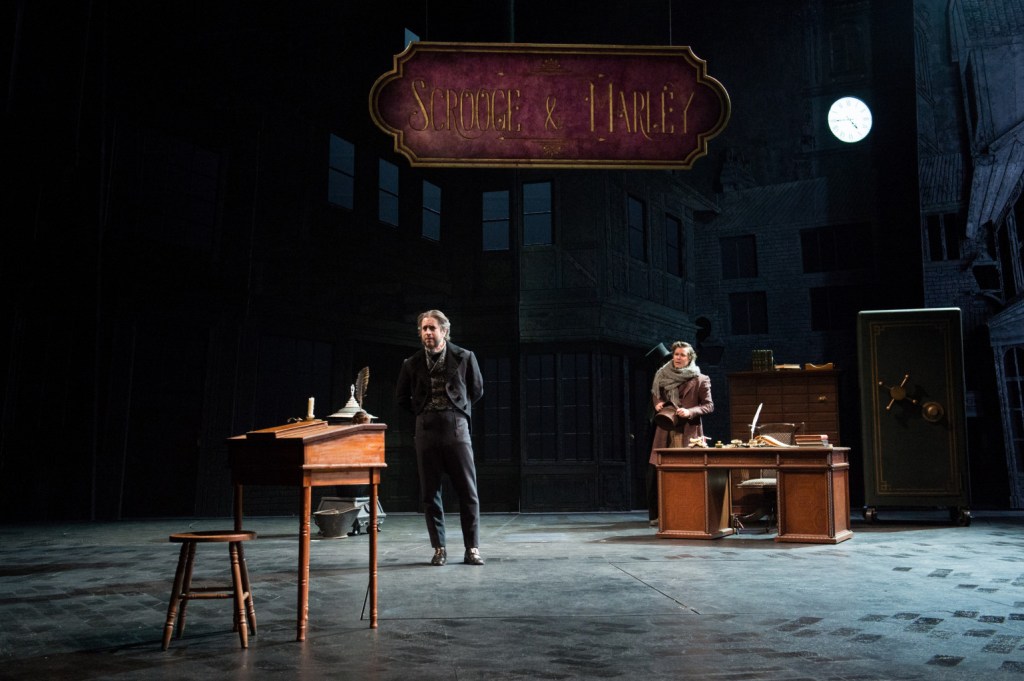
A New Interpretation of the Annual Guthrie Theater Production of A Christmas Carol is Worthy of its Legacy.

Matthew Saldivar (Ebenezer Scrooge) and John Catron (Bob Cratchit) Photo by Jenny Graham

If you’ve lived in the Twin Cities for a decade or more it’s likely you’ve seen one of the Guthrie Theaters annual productions of A Christmas Carol. It’s sort of a MN tradition, like Lefse at Thanksgiving. If you are new to town and haven’t gone yet, don’t worry you will, it’s as inevitable as taxes and the Vikings not going to the Super Bowl. Every production is different of course, casts change from year to year certainly, but for many years they utilize the same costume, set designs, and script. This year for the first time since 2010 they have completely reimagined the production. Using a new script by Lavina Jadhwani and Directed by Guthrie Artistic Director Joseph Haj, they have once again breathed fresh life into Dicken’s classic ghost story of Christmas. I like that The Guthrie has created this tradition. I like to think of families getting together once a year at the holidays to take in a live show every year, theatre as a tradition. I’m not implying that people should see A Christmas Carol at the Guthrie every year, but create that tradition. This show is probably too dark and scary for kids under 12, but there are plenty of other shows, Annie at the Children’s Theatre Company is perfect for them. When the kids get to the age of 12, introduce them to this MN Staple of Christmas. The next year find another show perhaps Penumbra’s Black Nativity, and then another, and then, well then probably circle back to A Christmas Carol. There is a reason it’s in it’s 47th year, people come back to it. Partly because it is one of those stories that resonates with all of us. The other reason is that every so often, this year being one of those times, they refresh the show from top to bottom. This reimaging is a welcome change and shows the story in a new way.

A Christmas Carol was first published as a Novella in 1843, in 1844 the first stage adaptations appeared. It tells the story of a miserly old business man Ebenezer Scrooge, who is visited on Christmas Eve by three ghosts sent by his old business partner Jacob Marley. The Ghosts are spirits of different times. The first is the Ghost of Christmas Past and shows him scenes from his past. Second the Ghost of Christmas Present, which gives him a look into the lives of those celebrating Christmas that year, including his nephew Fred, and the family of his clerk, Bob Cratchit. Lastly the Ghost of Christmas Yet to Come, wherein he sees his own future and people’s responses to it. The point of these visitations sent to Scrooge by Marley is so that he might learn the error of his ways and change while there is still time. Scrooge of course comes to realize how he changed over time and of the fruitlessness of such a selfish existence. By the end of the play he has found the spirit of Christmas and no longers thinks of it as a humbug. What this new adaptation does that is different from its predecessor is early on Scrooge’s desire to change. Not simply from be frightened by the ghosts, but we sense very quickly he has seen the errors of his ways and is trying to find the path to redemption. Rather than being frightened not to change, we see a Scrooge who is seeking change. This shift in focus is a real change from previous versions, it doesn’t alter the plot but it does make Scrooge more of an active participant in his own redemption. It is a positive message and fits well with Dickens themes and message.

Matthew Saldivar as Scrooge gives a good performance, he finds humor when appropriate but also sells the desire for redemption. His Scrooge did strike me as too young. This Scrooge struck me as decidedly late middle age, which wouldn’t seem odd, if it wasn’t such a familiar character and one that we usually associated as being a bit older. I don’t know if this was a choice to play him younger or if they missed the mark in capturing the age they were going for. The Guthrie always puts together a fine ensemble of actors. Some standouts in this production were John Catron as Bob Cratchit, whose embodiment of the glass is always half full philosophy felt like a sincere representation of a deeply good person rather than a fool who doesn’t realize how badly off he is. Also Emjoy Gavino as his wife, who is not quite as charitable as Bob, but won over as we are by his unwavering goodness. They play a very well matched couple and their banter rings true. Charity Jones as the Ghost of Jacob Marley is a performance that felt rather fresh, it wasn’t the usual slow talking moaning ghost, there was a little more there and that definitely worked well and marked this as a fresh take on the material. It was also nice to see some local favorites in the cast like Regina Marie Williams and Tyler Michaels King.

Aside from the script changes the biggest alterations are on the technical side including a new set design, lighting, and projection effects. For the most part I found all of the new elements worked really well. I like the set design, this old London cityscape that seems to tower over the characters. Shifting into different configurations so that new elements can be brought forward or rotated to reveal a new environment. While much of it as I say works there were a couple of things that didn’t. First off, the scenery has windows that can be seen through, on a couple of occasions I was distracted by seeing characters I shouldn’t moving behind the scenery. Secondly, and I suspect this was more of a technical glitch but the clock face flickered at one point during the show in a way that did not look intended. Lastly, was a short scene where Scrooge visits a ship out at sea. Firstly, it felt unnecessary, like a cool set piece with a cool projection effect included because they could create this cool effect. Secondly, in terms of the sea projection it is an effective technique but it stayed on far too long after that scene had ended. We were into the next bit, back on land, and it will still running. Another very well executed technical aspect was the Ghost of Christmas Yet to Come. The Costume Designer Toni-Leslie James has created a costume that frightened Scrooge onstage and I didn’t feel so brave myself. It is a marvel and though there is no dialogue for Rush Benson the actor in the costume, wearing and controlling it took talent and it is done very well.

A Christmas Carol plays through December 27th at the Guthrie Theater in Downtown Minneapolis for more information and to purchase tickets got to https://www.guthrietheater.org/

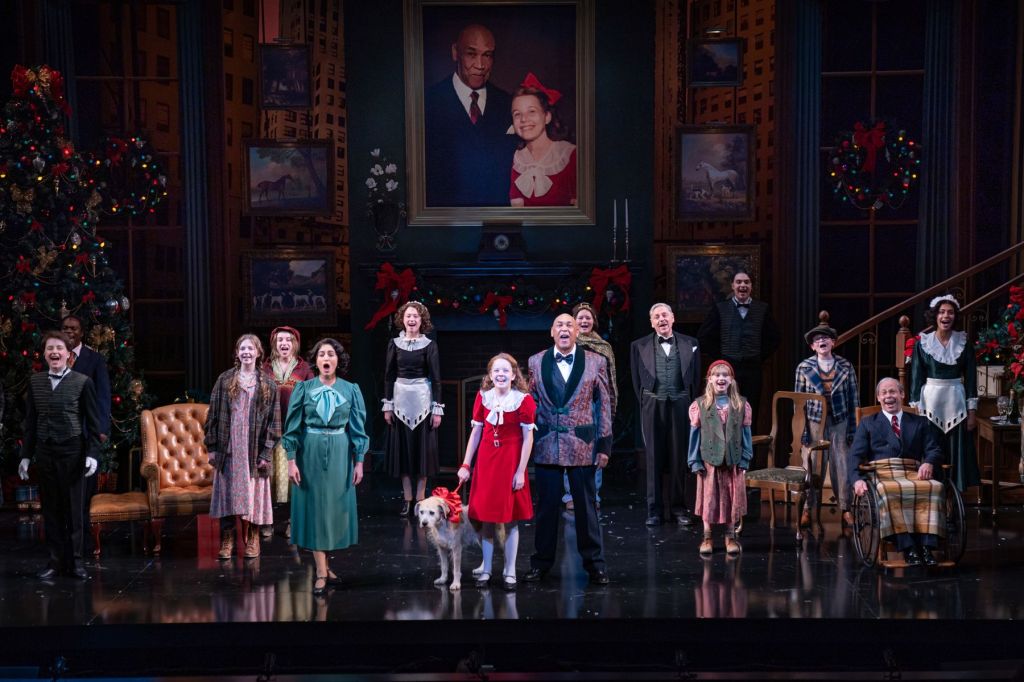
Annie At the Children’s Theatre Company is the Perfect Family Outing This Holiday Season.

Photo by Glen Stubbe Photography

The Children’s Theatre Company has decided to stage for their first show since the Covid Pandemic shut theatres down, Annie. It’s a great show, Children’s maybe going the route Disney used to before home video and restaging when the next generation comes of age to enjoy it. That would be an ideal model, Annie is full of memorable songs and a nice dose of humor, making it a great introduction to live theatre for audiences. The original Broadway production debuted in 1977 with Book by Thomas Meehan, Music by Charles Strouse, and Lyrics by Martin Charnin. You can’t go wrong with this show and CTC has mounted an excellent production. An elegant set, a great cast make for the perfect outing this holiday season in the tradition of the annual pantomime.

Annie is set during the great depression, depending on the age of the child you might take, this can be an in to discussing a bit of history as well. Annie and her friends lives in an Orphanage under the strict eye of Miss Hannigan, who incidentally hates kids. Unlike the other orphans, Annie has hopes that she will be reunited with her parents. She has a locket and a note that was left with her by her parents. It says that they will be back for her when they can and will keep the other half of the locket so they will know each other when they come back. Annie has been waiting 11 years for them to come back and decides she has waited long enough. She sneaks out of the orphanage in the laundry basket and sets off to find them. Before long she has made friends with a stray dog, Sandy, but just as quickly she is caught by the police and taken back to Miss Hannigan. Luckily before Miss Hannigan can exact retribution on Annie, she is plucked from the orphanage by the personal secretary of billionaire Oliver Warbucks, Grace Farrell. Warbucks has decided to have an orphan stay with him for two weeks over the holidays. Before long, Annie has won over the industrialist and he has decided to adopt her. But when he learns of her note and locket it agrees to help her find her real parents. Enter Miss Hannigan’s Brother Rooster and his girl Lily St. Regis, who will cook up a scheme to pose as Annie’s real parents using Miss Hannigan’s inside knowledge of Annie’s locket and the note. Will they get away with it? Will Annie and Sandy ever be reunited? You can probably guess but you’ll have to see the show to know for sure!

There are two actresses playing the role of Annie on alternating days, I saw Lola Ronning and she was great! A nice singing voice and a stage presence that put her on equal footing with her adult counterparts. She never, and this is true of all the young actors, appears to be acting. She is just in character and completely natural. Other standouts in the cast are JoeNathan Thomas as Oliver Warbucks. Thomas was able to convey a busy man running an empire a complete master of his world, that also has a tender heart which is easily won over by Annie. His duet with Ronning on “I Don’t Need Anything But You” shows off both his musical chops and his naturalness with the young performer, there seemed to be genuine affection between them and a pride in the work Ronning was doing. Reed Sigmund is clearly having a lot of fun with the role of Rooster, his performance making it clear why they call him Rooster. And a standout in the excellent cast of ensemble players was Dean Holt who played multiple characters, each distinct. My favorite was Lt. Ward, who seemed like he stepped right out of a Frank Capra or Preston Sturges film from the 1930’s.

Directed by Peter Rothstein he keeps the show moving along nicely keeping the younger audiences attention for the most part. The Set Designer Vicki Smith has created a very practical yet elaborate set whose transitions between multiple locations are quick and fluid and each setup is a marvel. The sets and the environments they create may be more important in a children’s show than in an adult one. I think they can have their imaginations ignited by the creativity they see before them. Smith creates an orphanage, a mansion, a cityscape complete with overpass and skyscrapers. Lighting Designer Paul Whitaker helps to complete the feel of a 1930’s film. The Musica Direction by Victor Zupanc and the the orchestras performances are spot on. The show is filled with memorable songs like “Hard Knock Life”, “Tomorrow”, and “Maybe”

Annie runs through January 9th 2022 for more information and to purchase tickets go here https://childrenstheatre.org/.

New Production of “Oklahoma!” At The Orpheum Oh What a Beautiful Revival!

Photo By Matt Murphy for MurphyMade.

Richard Rodgers and Oscar Hammerstein II are Icons of the Broadway Musical, collaborating on five of the most well known golden age musicals: Carousel, South Pacific, The King and I, The Sound of Music, and of course Oklahoma!. Oklahoma! was the duo’s first full collaboration, which premiered on Broadway in 1943 and won a special Pulitzer Prize in 1944. One might expect that a show nearly 80 years old might have little to offer a modern audience. One would be mistaken. If you want to teach a young person about the art of theatre show them the Classic film version of Oklahoma! (1955) and then take them to see this revival. Without altering a word of the text the show takes on new meaning, the staging and performances demonstrating the way choices made by directors and actors can greatly affect a production. It is a reminder of why great works should be restaged and reinterpreted. There are choices made by individuals that can uncover new meanings. The new version is darker particularly in the ending. But, the show also contains a lot of humor and has all those classic songs by Rodgers and Hammerstein. This may not be the show to take Grandma too, even if she loved the film version, but it should play well for younger audiences, including teenagers. I would hope the ending in particular would illustrate something to the younger generation. This revival of Oklahoma! breathes new life into an American classic by more accurately portraying the America of today.

This revival which launched on Broadway in 2019 is directed by Daniel Fish. Fish along with Projection Designer Joshua Thorson and special effects creator Jeremy Chernick are responsible for the most impactful elements of the production. Fish has created a seismic change in the tone of the show. It is still the story of two love triangles: Laurey and her two suitors, Curly the Cowboy and Jud the Farm hand, and Ado Annie and her Cowboy the mathematically challenged Will Parker and the peddler Ali Hakim, who will do whatever he can not to win her hand in marriage. The audience has no doubt who either will end up with. Curly and Laurey have a Sam and Diane thing going, or if you are not a child of the 80’s, a Benedict and Beatrice thing. Plus it’s clear that Jud would be a candidate for school shooter in our times. You don’t need Shakespeare or Cheers to show you that Ado Annie isn’t going to end up with the guy who desperately doesn’t want to be with her over the man who repeatedly spends his last cent to try and win her hand. One change Fish has made that worked and didn’t work was in the Dream ballet. It works in that it’s an interesting and absorbing dance routine done in this version by a single dancer wearing a shirt saying “Dream Baby Dream.” It doesn’t work in that in changing it from the cast acting out a dream to simply an individual interpretive dance it loses its meaning for those not familiar with the concept that this sequence is supposed to be happening after she uses the Egyptian smelling salts and is reflecting the confusion she is having over her feelings for Curly and her anxieties and fear of Jud. Another aspect which does still work with this sequence is the use of video projection. Again I don’t see how the uninitiated will be able to grasp the concept of the ballet as it’s presented but it does add a quality to the sequence that, while not forwarding the story as the ballet did in previous versions, is all the same compelling. The video projection technique is used in a couple of scenes, where they basically have someone with a night vision video camera recording and casting through a projector the action that is happening on the darkened stage. The special effect that creates an impact and visually illustrates the message of this new production comes towards the end, so I’ll leave you to experience that for yourselves.

The casting of the 2019 revival was notable for its inclusiveness. Ali Stroker famously became the first wheelchair user to win a Tony Award for her portrayal of Ado Annie. I was pleased to see the touring company kept the casting colorblind and also chose to cast Ado Annie with another nontraditional choice. In this production Ado Annie is played by Sis, a black Transgender actor, who frankly steals the show. Ado Annie’s most famous song is “I Can’t Say No” and Sis’ performance resulted in a standing ovation in the middle of Act I. The rest of the cast is cast without an eye towards race. It’s nice to see the Hamilton effect in action. Sean Grandillo does a nice job as Curly. At first I wasn’t sure, but it didn’t take long for me to be won over by his guitar wearing interpretation, and I thought he had good chemistry with Sasha Hutchings’ Laurey. The other stand out was Christopher Bannow as Jud. The choices made with this character led one to see him as creepier than other versions while at the same time adding a sense of sympathy as he came across less as sinister and more are someone with some mental health issues. Bannow did a nice job of conveying this to the audience. Also making his last actions in the musical more ambiguous adds to the shift in tone that resonates more with a modern audience.

Oklahoma! runs through Sunday November 14th at the Orpheum Theatre in Downtown Minneapolis for more information and to buy tickets go to https://hennepintheatretrust.org/events/oklahoma-broadway-tickets-minneapolis-mn-2021/

Theatre Pro Rata Presents “Top Girls”a Stripped Down Production of a Thought Provoking Play

Pictured: Maggie Cramer, Nissa Nordland Morgan, Emily Rosenberg, Kelsey Cramer, Sarah Broude
Credit: Alex Wohlhueter

Theatre Pro Rata’s latest play is a marvel of construction and ideas. I’ve found myself thinking about the subject matter long after I would normally have started writing. Top Girls is a play written by Caryl Churchill and set in Great Britain in the early 80’s. It examines the roles available to women in our society at that time and what the cost of success can be. It looks at the subject matter by comparing and contrasting it with women from the past and by showing us various women interacting with each other. All characters that appear in the play are female but the male perspective is not entirely absent. It is felt in the way the characters behave and react to their circumstances. Sometimes they are showing us what they have to do in order to make it in a still heavily Patriarchal society, at others we see them model the same patronizing attitudes they hate from men towards each other. It is a play full of complex characters that showcase the ambiguities of humanity – an important work that challenges the audience to keep up. Unfortunately, this production of an amazing script stumbles at times to translate the ideas beyond the stage to those of us in the theater seats. It’s not a bad production, there is a lot to like here and it’s a rare opportunity to see this classic of modern theatre performed. I urge you to attend and I’ll try and give you some pointers on how to get the most out of it.

The play opens in a restaurant. We see Marlene who is here to celebrate her promotion as head of the Top Girls Employment Agency. She is joined by women from the past both historical and fictional. They proceed to converse and eat, each of the women relating their experiences, the scene written and performed in such a way that the dialogue overlaps. We might not catch everything that’s said, as is often the case at a larger dinner party, with conversations happening at opposite ends of the table. Although all this isn’t occurring in the real world of the play, but is a representation of an idea being played out: “What if you could have dinner with anyone from history?” This is an interesting way to begin the play, showing us the roles and experiences of women through time. I like this idea of creating the atmosphere of the dinner party, and it seems to me by the end that in many ways these various women were different aspects of Marlene and the other characters, but unfortunately this opening scene is also where the production falters.

Firstly, the stage is set in the middle of the theatre and there are chairs on both sides for the audience. The problem with Director Carin Bratlie Wethern’s staging the production like this is that if you are not micing your actors, much of the dialogue is inaudible. I got there a little later than I like to and so was seated to the side, but I was still in the second row and it isn’t a large theatre. The character of Pope Joan for instance was seated with her back to me for most of the scene and even though she was the closest to me I rarely could make out her dialogue because she is talking in concert with other characters and speaking away from me. This happened with multiple characters. The second issue with the scene is that it isn’t clear what is happening here.
Partly due to lost dialogue, this concept of a fantasy dinner takes much too long to really become clear. There needed to be some way to convey that this was not reality up front. An example perhaps of the value a Director’s note in a program can add. The costuming also would have been a way to make clearer who these women were from the start. While the costumes by Eleanor Schanilec convey the idea of who these people are, this is an area where more would have sold the idea to the audience a lot faster. Thankfully, after this scene and a short one right after it that features two young friends talking, the staging and audibility issues were largely eliminated. The play is told nonlinearly with the final scene being the earliest chronologically, it’s revelations affecting how we view Marlene and the earlier scenes. After the opening scene rest of the play is set in the real world and involves Marlene and the other employees at Top Girls, as well as clients, Marlene’s sister Joyce, her niece Angie and her friend Kit.

Aside from needing to project more to compensate for the staging, the entire cast does a great job, most of them essaying multiple roles, with the exception of Maggie Cramer in the lead. The stand out for me was Emily Rosenberg, who played Dull Gret in the opening dinner scene. Rosenberg spends most of the scene delivering one word answers, so when they climb up on the table and talk about marching into hell, the entire audience took note. It is a speech delivered with power and backed by the surprise of it’s unlikely source. Rosenberg also plays the niece Angie who, in some ways, is an extension of Dull Gret. In both roles they find a way to surprise us, and in a play very focused on ideas, they provide the emotional in for the audience. Maggie Cramer as Marlene and Kelsey Laurel Cramer as her sister Joyce have a brilliant interaction in the final scenes where our sympathies change. It really is a brilliant script. The cast is rounded out by Megan Kim and Nissa Nordland Morgan as the employees of Top Girls, with Sarah Broude and Ninchai Nok-Chiclana as clients in little vignettes illustrating the complexities of these women: their roles, their strengths and their weaknesses – at times supportive of each other, at times cruel and petty. Kelsey Laurel Cramer has a scene as the wife of the colleague that Marlene beat out for head of Top Girls. We see her try to help her husband, certainly a kind gesture, but without realizing that in doing so she is making the argument that women don’t matter as much as men. It’s such a pleasure to see a play where even a five minute role has nuances and shades of character that some main characters don’t have in other plays.

Top Girls is worth your time. It will make you think and make you questions things, including, by the end, what you thought of the first half. Top Girls runs through November 21st at the Crane Theatre in northeast Minneapolis. For more information and to purchase tickets click here https://www.theatreprorata.org/. I recommend getting there early, seating is General Admission. I’d suggest sitting front row dead center if you can manage it. Hopefully with that placement and a heads up of what is happening in that first scene you will really be able to key in from the beginning.

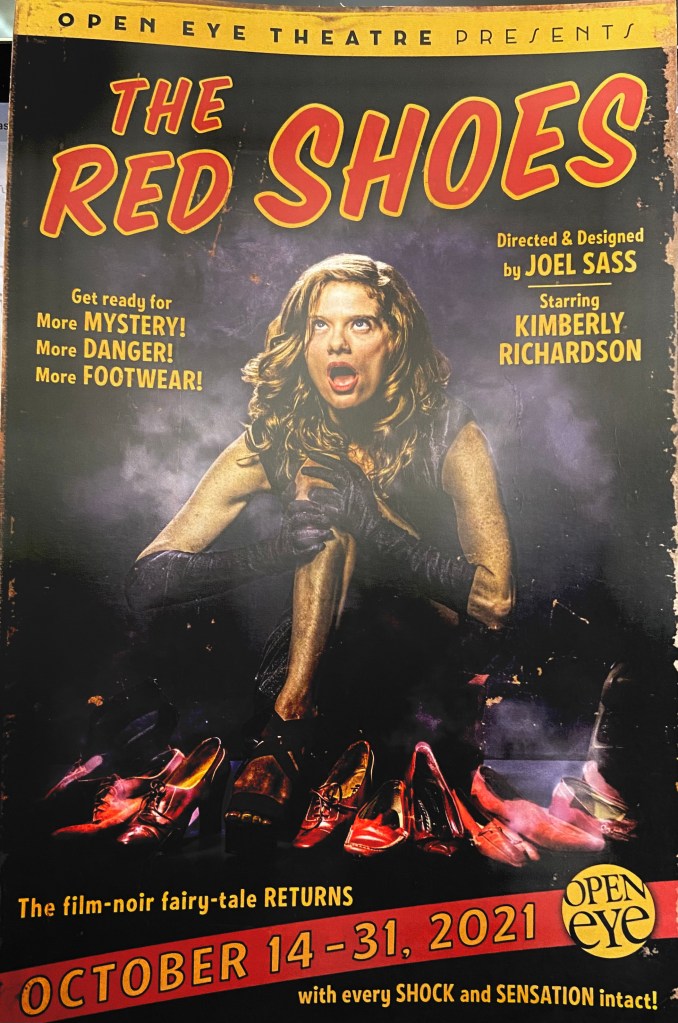
(Updated) A Shoe I Can’t Get Out of My Head, The Red Shoes at Open Eye Three Shows Left, But Sadly One is Sold Out Already!!

Photo by Ron Ravensborg and Graphic by Holmes Design

So This has never happened to me before, I’m taking another stab at this review. Normally time simply doesn’t allow for it. But due to time constraints and a desire to get my review up ASAP so people had time to catch this amazing show before it closed I posted even though I wasn’t entirely happy with it. When you see one of the best shows you’ve seen since you began reviewing you want that review to be one of the best as well. Well I’m not going to put that pressure on myself but I do want to get it to a point where It isn’t gnawing at me that I could have done better.

Thank God this show was held over for another week or I would have missed it and so would’ve you. The Red Shoes still has these added shows; Thurs, Nov. 4, 7:30pm, Fri, Nov. 5, 7:30pm, Sat, Nov. 6, 7:30pm. Sadly Thursday has sold out, making it the 9th consecutive performance to have sold out. Thankfully not before I snagged three more tickets so my wife and I could seeit and take my eldest son. Go to https://www.openeyetheatre.org/the-red-shoes for more information and to buy tickets. I’ll wait while you go buy tickets, do it now, they may be gone before you finish reading this. Done? OK let’s get started. First of all when you go, keep all hands and arms inside your chair at all times, at least that’s what they should have said. From the second the house lights went down and the show experience began, I felt like I was on a theme park ride. There are certain shows that function as testimonials to what a magical thing theatre can be, that highlight creativity and fully immerse you in their own unique reality. The Red Shoes is just such a show. This is artists working at the highest level in Production design, Lighting, Sound, Costume, Puppetry, not to mention Direction and Performance. This is the reason I do this. Shows like this that you immediately want everyone you know to see as well. The Red Shoes is not only firing on all cylinders, the people behind it actually built the cylinders from scratch.

The plot reminds me of the Bogart classic The Big Sleep, in that you are not sure it all adds up at the end but you don’t care because the journey to the end of the line was so good. To give you an idea, the main character is a mousy woman who never leaves her apartment, she seems to be trying to figure out who she is by reconstructing memories or perhaps dreams using a miniature design of locations and puppets. She is terrified of the phone and of anyone coming to the door. She is badgered by her relentless Landlady, sympathized with by the local Newsboy, and stalked by a mysterious figure in a trenchcoat. There is something very interesting about all of these other characters but one hopes to leave that as a surprise. The wonder of this show is the surprises and the execution of them.

Kimberly Richardson plays the main character, assisted by Sabrin Diehl, Noah Sommers Haas, and Kalen Rainbow Kier, but it is Richardson’s show all the way. It’s a tour de force of physical and vocal dexterity. We wholly buy her timidity as the play opens, terrified of the ringing phone and her landlady who’s comments come through a very unexpected source. But she equally sells other characters as she acts out the nightmares with her puppets. The fairy tale on which the show draws its inspiration tells the story of a vain girl who after choosing to dance rather than attend her mother’s funeral is cursed to dance even after she dies. This version does not follow that plot but there are clues within it that might help us understand what we have seen. There is some dance, just enough to show us that Richardson is someone in complete control of her body. As fascinating as Richardson is in the central role, it’s not her only job, she also co-wrote the play and choreographed it.

As talented and engaging as Richardson is, the true star of the show may just be the Productions technical crew. As I sat preparing for the evening’s performance to start I was impressed with the sets design by Joel Sass and the lead Scenic Artist Michael Sommers. It has the look of a set but in all the right ways, there is a storybook quality to the 40’s era apartment that feels heightened. There are set designs that look like real locations and then there are set designs that look like sets, both have there place depending on what the production is going for. This was perfect for the nightmarish world we are witnessing. It has the feel of a film noir movie set as designed by Dr. Seuss. The set construction by Brandon Sisneroz and Sommers Haas is a marvel, when the show starts, it comes alive in truly original ways. Unlike some shows which amaze you at the start by spilling all their secrets up front, this one continues to surprise right up until the end. But it isn’t just the set. The play opens with a combination of lighting, sound, and smoke effect that announced right from the start that this was going to be a rollercoaster of an evening. Thrilling and visceral work from Bill Healey in Lighting Design assisted by Ellie Simonett. Sean Healey’s Sound Design puts you inside the play in a way I’ve never experienced before. I was filled with wonder and amazement at what I was seeing and with what these artists came up with to express their vision.

There is nothing more inspiring than seeing creativity brought to life in such a palpable way. One leaves the theatre wanting to create something to express the joy you feel inside at the marvel you have just witnessed. This production is in the top ten in person theatrical experiences I have ever had. It reminded me of the thrill I had in the spring of 2019 when two productions led me to repeat attendances, bringing new people with me each time. That is what gave me the idea to become a theater reviewer, that desire to share something that knocked my socks off with others. The Red Shoes brought me right back to spring 2019 and I started urging everyone to get tickets, see it! And that is the reason I had to take another pass at this review. Because it felt like this show represented why I have dedicated so many hours in theatre seats and twice as many at a keyboard writing about them. Because it inspired me to share. I still don’t think I’ve done the show justice, but it’s unfair to hold myself up to the standard of this production. If I’ve inspired a few people to see this show, and I know I have, that is enough to have made the ride worthwhile. The Red Shoes is everything theatre can be while at the same time being uniquely its own. What a beautiful thing that is to behold. I urge you not to miss your chance to experience The Red Shoes.

WOW! Just WOW! The Red Shoes at Open Eye Theatre Held Over for One More Week. One More Word… GO!!!!

Photo by Ron Ravensborg and Graphic by Holmes Design

Thank God this show was held over for another week or I would have missed it and so would’ve you. The Red Shoes has added the following shows; Mon, Nov. 1, 7:30pm Industry Nite, Thurs, Nov. 4, 7:30pm, Fri, Nov. 5, 7:30pm, Sat, Nov. 6, 7:30pm. Go to https://www.openeyetheatre.org/the-red-shoes for more information and to buy tickets. I’ll wait while you go buy tickets, do it now, they may be gone before you finish reading this, the last seven shows sold out. Done? OK let’s get started. First of all when you go, keep all hands and arms inside your chair at all times, at least that’s what they should have said. From the second the house lights went down and the show experience began, I felt like I was on a theme park ride. There are certain shows that function as testimonials to what a magical thing theatre can be that highlight creativity and fully immerse you in their own unique reality. The Red Shoes is just such a show. This is artists working at the highest level in Production design, Lighting, Sound, Costume, Puppetry, not to mention Direction and Performance. This is the reason I do this. Shows like this that you immediately want everyone you know to see it as well. The Red Shoes is not only firing on all cylinders, the people behind it actually built the cylinders from scratch.

The plot reminds me of the Bogart classic The Big Sleep, in that you are not sure it all adds up at the end but you don’t care because the journey to the end of the line was so good. To give you an idea, the main character is a mousey woman who never leaves her apartment, she seems to be trying to figure out who she is by reconstructing memories or perhaps dreams using a miniature design of some locations and puppets. She is terrified of the phone and of anyone coming to the door. She is badgered by her relentless Landlady, sympathized with by the local Newsboy, and stalked by a mysterious figure in a trenchcoat. There is something very interesting about all of these other characters but one hopes to leave that as a surprise. The wonder of this show is the surprises and the execution of them.

Kimberly Richardson plays the main character, assisted by Sabrin Diehl, Noah Sommers Haas, and Kalen Rainbow Kier, but it is Richardson’s show all the way. It’s a tour de force of physical and vocal dexterity. We wholly buy her timidity as the play opens, terrified of the ringing phone and her landlady who’s comments come through a very unexpected source. But she equally sells other characters as she acts out the nightmares with her puppets. The fairy tale on which the show draws its inspiration tells the story of a vain girl who after choosing to dance rather than attend her mother’s funeral is cursed to dance even after she dies. This version does not follow that plot but there are clues within it that might help us understand what we have seen. There is some dance, just enough to show us that Richardson is someone in complete control of her body. As fascinating as Richardson is in the central role, it’s not her only job, she also co-wrote the play and choreographed it.

As talented and engaging as Richardson is, the true star of the show may just be the Productions technical crew. As I sat preparing for the evening’s performance to start I was impressed with the sets design by Joel Sass and the lead Scenic Artist Michael Sommers. It has the look of a set but in all the right ways, there is a storybook quality to the 40’s era apartment that feels heightened. There are set designs that look like real locations and then there are set designs that look like sets, both have there place depending on what the production is going for. This was perfect for the nightmarish world we are witnessing. It has the feel of a film noir movie set as designed by Dr. Seuss. The set construction by Brandon Sisneroz and Sommers Haas is a marvel, when the show start, it comes alive in truly original ways. Unlike some shows which amaze you at the start by spilling all their secrets up front, this one continues to surprise right up until the end. But it isn’t just the set. The play opens with a combination of lighting, sound, and smoke effect that announced right from the start that this was going to be a rollercoaster of an evening. Thrilling and visceral work from Bill Healey in Lighting Design assisted by Ellie Simonett, Sean Healey in Sound Design. I was filled with wonder and amazement at what I was seeing, and with what these artists came up with to express their vision. There is nothing more inspiring than seeing creativity brought to life in such an amazing way.