Redwood Deals with Challenging Issues of Race and Identity with Humor and Humanity at the Jungle Theater

Thomasina Petrus, Bruce A. Young, Dana Lee Thompson, China Brickey, Kevin Fanshaw. Production Photos by LAUREN B. PHOTOGRAPHY

I don’t know why when I review a show that deals with race I feel compelled to acknowledge that I am a middle aged White Male. First off, if you haven’t seen a photo of me, surely the name says it all. Secondly, should it even matter? Well, I think it does. I think I need to acknowledge upfront that like the non black characters in Redwood, however much I want to empathize and understand, I have to realize I can never really fully do that. I can feel and say “that’s horrible”, but I can never fully relate. So I state that. I say upfront what my perspective is and I offer my thoughts from my point of view. So the following is how this play Redwood, told from the black perspective by playwright Brittany K. Allen and director H. Adam Harris, spoke to me.

Redwood while created from the black perspective is told through the interlocking stories of multiple characters, not all of which are black. There is Uncle Stevie who’s genealogy project/obsession is the catalyst for much of action in the play. He is a “funemployed” middle aged man who fills his time trying different classes at the gym such as hip-hop dance and yoga for pregnant women. We have his twin sister Beverly, whose husband is out of town on business for a suspiciously long time. There is her daughter Meg and her white boyfriend Drew. There are other characters that pop up as well usually for one or two brief but important scenes but these four characters are the ones whose perspective we are invited to view the play through. We hear Stevie’s enthusiastic emails to the family about his newest discoveries and requests for them to share their info and DNA. Beverly and Meg discuss Stevie’s project but don’t really internalize. That is until Stevie reaches out to the white side of the family that branched from the slave owner Tatum. When it’s revealed that Drew is a descendant of Tatum’s as well it causes Meg and Drew problems in their relationship. The plays main theme is inherited trauma, how it affects the way we view the world and can affect our relationships and culture. It also examines the effects of that on interracial relationships.

These are important and powerful issues that Redwood is dealing with. The play could easily have felt like a message or a lesson play but Allen’s script sidesteps that beautifully. The play relies heavily on humor and humanity to explore it’s themes. Yes, we leave the theater with a lot to think about, but while we are in the theater we are entertained by characters that we can relate to. These are characters struggling with how to process information that is hard to internalize. We see them react in real ways, I was struck by how grounded in reality the characters were. There is a subtlety to some of the characterization that makes it real. Beverly describes her husband’s criticism of how she reacts whenever things get serious and we realize that is how her daughter Meg responded in an earlier scene with Drew. It isn’t driven home, it’s left there for us to catch or not catch, but it reinforces that theme of heredity and its impact on how we live. This is a coping mechanism that Beverly has passed down to her daughter. Black or white there is a lot to relate to in Redwood. It speaks to all of us because we are all represented. It isn’t my story, but there is someone for me to identify with racially. But perhaps the most important thing is there are aspects of all of these character that I can relate to. On the one hand we have Stevie, searching back into the past to understand where he came from. We also have Meg and Drew trying to look to the future, for me they represent how we have to come to terms with the past and understand our differences but not let that affect our willingness to try and build a future. The name of this play is so perfect. Redwoods are trees that can live for thousands of years, they have a long history. They also have root systems that spread out and intermingle with the roots of other redwoods. This is a play about family trees, about history about the way we intermingle to become a society. The play looks at interracial relationships and the struggles that can be unique to those, but it also shows the struggles and rewards that are inherent in all relationships. Beverly’s marriage is not interracial, but it has hit a rough patch. Allen is reminding us that struggle is part of all relationships but through Meg and Drew we also see that there can be love and reward in all relationships as well. In an ideal world, if this one still exists in 100 years, most families will be interracial. Hopefully we evolve to the point where we have dealt with the inherited traumas, and we have gotten past the color of our skins and simply love the person we fall for.

The collaboration of Allen the playwright and the director Harris feels like the perfect realization of this work. Allen’s script is the perfect vehicle to explore these issues because it is inviting us to explore them through its use of humor rather then lecturing to us. She has a real talent for writing characters that feel real and every beat seems to build the story, themes, and characters up. Harris stages the show in a way that we move effortlessly from scene to scene. We flow back and forth among the four primary characters as they interact with each other in different locals. With this much scene changing we could have felt like we were spending half the play in transition. Harris keeps the set design multifunctional, we transition locals by primarily shifting our focus from one area of the stage to another. The importance of transitions cannot be overestimated. I have sat through many productions that labor through scene changes and nothing breaks the momentum of a play like sitting and watching either characters or stagehands spend 45 seconds between scenes resetting the stage. This show is fluid, it isn’t hung up on trying to recreate reality in every scene, in fact some of its boldest moments are when we are decidedly not in the here and now of the real world. The set design by Sarah Bahr and lighting design by Karin Olson is another collaboration that soars in this production. The main stage easily becomes in our minds eye the gym, Stevie’s apartment, a coffee shop, the past. Stage left Beverly’s home, stage right Drew’s parents home, downstage meg and Drews apartment. Everything seems straightforward and then every once in awhile something happens usually involving the lighting and the set becomes more than the sum of it’s settings. There is a particularly powerful moment towards the end that seemed through the lightening to change the shape of the set. Dan Dukich sound design was also integral particularly in its use of providing echoes from the past.

The cast is greatly filled with local talent that has entertained me for years. There’s Max Wojtanowicz, Dana Lee Thompson, Dwight Xaveir Leslie, and Morgan Chang as the chorus and smaller character roles. Leslie nails the upbeat gym instructor struggling to respectfully tell Stevie to get a life, and man does he have some moves in the hip-hop dancing class that opens the play. Wojtanowicz gets the distant white Dad down to a tee, and Chang shows us the stepmom that tries to connect but not overstep. Thompson’s key role is as Alameda the ancestor who gave birth to Stevie and Beverly’s branch of the family. She has a powerful moment at the end when she speaks her truth as do the others, each is a revelation. Hers in particular lands as unexpected but truthful, it’s one of the darkest but truest moments in the play. China Brickley as Meg and Thomasina Petrus as Beverly play a mother and daughter well, they have an easy give and take for the day to day stuff, but both find the truth in their evasions of difficult matters. They both are hiding things about their relationships with their men and you can feel the mother-daughter sameness in behavior, which really sells the relationship. Kevin Fanshaw’s Drew gets the middle class son dealing with parents who seem not to hear or choose not to. For the role of Stevie the part is alternating between two actors. T. Mychael Rambo, whom I did not see but I know you’ll be in good hands from his previous work. Bruce A. Young played Uncle Stevie on the night I saw the show. Without a doubt my favorite performance of the night. His enthusiasm for his genealogy project felt genuine as did his annoyance at the other members of the family who were not responding to his requests. His scene with Drew is a masterful display as he plays the older man toying with the youngers insecurities and discomfort. I really felt his presence in every scene, his character is more outgoing than the others but it wasn’t just that, he held one’s attention even in the quieter moments.

Redwood is playing at the Jungle Theater thru March 13th. It’s the perfect kind of play it entertains you but also gives you a lot to think about. It’s a way to explore and discuss difficult themes but in a way that feels real and useful and productive. And it’s pretty funny. For more information and to purchase tickets go to https://www.jungletheater.org/.

Oh What a Night! “Jersey Boys” Brings Classic Songs to Life at the Orpheum

(l to r) Devon Goffman, Eric Chambliss, Jon Hacker and Matt Faucher
Photo: Joan Marcus

Jersey Boys is one of those shows that has somehow always eluded me. Either too busy or too broke when it’s been to the Cities in the past and for some reason I’ve never taken in the Clint Eastwood film. I think I knew I wanted to see it on stage for the first time. I’ve always had an affinity for this music. Maybe it was listening to the oldies station on the car radio with my Dad growing up. Maybe it’s just my kind of music. So for a Jukebox Musical this show was primed to be a favorite. It did not disappoint. Jersey Boys is filled with classic songs, what a period in music to draw from and what a string of great songs The Four Seasons had.

The show was written by Marshall Brickman and Rick Elice with music by Bob Gaudio and Lyrics by Bob Crewe, featuring the songs of The Four Seasons and others from the period. It tells the story of the formation of the band, their success, and breakup. The story is told from the points of view of the four men who made up the band. Bob Gaudio, Tommy DeVito, Nick Massi, and of course Frankie Valli. What’s interesting, and was unexpected, was that the show is divided into four season, beginning with Spring and ending with Winter, each of the season is told from the Point of View of a different one of the guys. While the story always moves forward, they do reference back to bits that happened before and try and set the record straight from their perspective. It’s an interesting story and there were a lot of details I didn’t know anything about. The script does an excellent job of pushing the story along without feeling rushed, never getting bogged down in one section but also you never feel anything was skipped over. Punctuating the story with humor in just the right amount. It’s fun, informative, and filled to overflowing with great songs.

The show is supported by great musicians and supporting performers. A show is only as good as its weakest link. Luckily, this show doesn’t have one that I could identify. Of the leads the stand out is Jon Hacker as Frankie Valli. Does he sound just like Valli? Not quite, but not many people can; however, he comes pretty damn close, which in and of itself is something of a miracle. Hacker along with Eric Chambliss as Bob Gaudio, Matt Faucher as Nick Massi, Devon Goffman as Tommy DeVito are all great on their own, but when they harmonize it’s like a little bit of magic. The four leads do such a great job of recreating the sound of The Four Seasons. I felt if I closed my eyes I would be back in the car and I could hear my Dad next to me, singing along. Oh what a night, and it ended much too soon.

Jersey Boys has played Minneapolis many times already but if you haven’t ever pulled the trigger I encourage you to finally do so. If you’ve seen it before, chances are you already have your tickets to see it again. The show only plays through this Saturday February 5th. To purchase tickets and for more information go to https://hennepintheatretrust.org/events/jersey-boys-broadway-tickets-minneapolis-mn-2022/.

Rentheads see where it all began Puccini’s “La bohème” At Theater Latté Da

Siena Forest and Benjamin Dutcher. Photo by Dan Norman.

My headline is meant to grab your attention rather than being completely accurate. While La bohème (1896) the Opera is the inspiration for Jonathan Larson’s masterpiece Rent (1996), it isn’t the ultimate source of the material. La bohème is itself based on the novel Scènes de la vie de bohème (1851) by Henry Murger. It’s part of the creative act to reinterpret, adapt and reinvent that which has come before. There is no West Side Story for example without Shakespeare’s Romeo and Juliet. We need to look no further than Steven Spielberg’s new film adaptation to see that even just producing a new version of an existing work can revitalize it and find new things to say to an audience. Rent isn’t the only modern work that has taken inspiration from La bohème. Baz Luhrmann who directed a very popular production of La bohème has acknowledged it as one of many inspirations for his musical film Moulin Rouge! (2001). Acknowledging these antecedents and understanding the role that they have on creative work is important in understanding the act of creativity. What a treat it was to experience La bohème for the first time in Theater Latté Da’s intimate new reimagining.

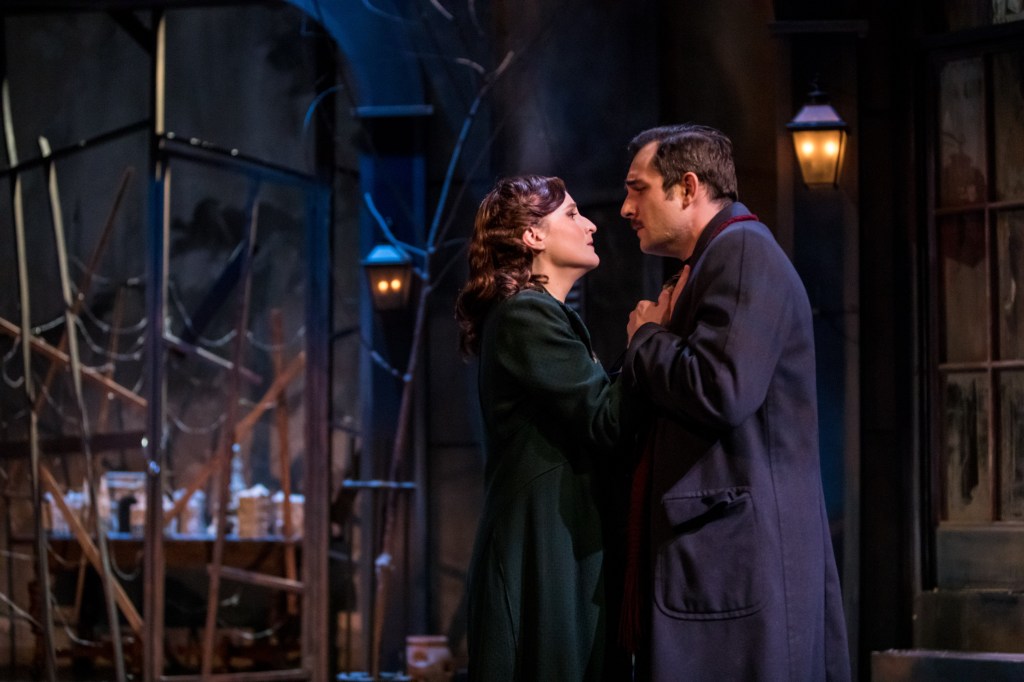
La bohème is the story of a group of poor struggling artists living in Paris, in this production set during the Nazi occupation. Rodolfo a writer and Marcello a painter share a garret which they heat by burning the pages of Rodolfo’s writings. Their friends Colline and Schaunard arrive, Schaunard has had a windfall and comes bearing food, wine and money. When the landlord arrives asking for the rent, they flatter him and loosen his tough with wine, they get him to tell of his romantic assignations. After admitting to some he also reveals he is married. The friends feign indignation and order him to leave before he corrupts them with his immoral behavior. And thus they avoid paying the rent. Three of the friends head to the Cafe Momus to celebrate, Rodolfo stays behind to finish writing an article before joining them. There’s a knock on the door, it is Mimi a neighbor who’s candle has gone out. It’s love at first sight for Mimi and Rodolfo they go to join his friends at the Cafe Momus where we are introduced to Marcello’s ex Musetta. The rest of the Opera will follow the ups and downs of these relationships.

The more Opera I see the more I become attuned to it. La bohème is performed in Italian with the lyric’s projected above the action. This works surprisingly well. The style of Opera singing, the words are held for longer, this allows you to read the lyrics and then still be able to take in the performances. Everyone in the cast are fine vocalists. There are several roles which have alternate performers depending on the day. The performance I attended featured Siena Forest and Benjamin Dutcher as Mimi and Rodolfo (pictured in the Photo above) Forest was an excellent Mimi, aside from her voice which was beautiful, she conveyed a sense of adoration for Rodolfo in a performance that began in her eyes and radiated outward from there. Dutcher is a favorite that I seem to be seeing everywhere lately, a performance at Crooners in the summertime and just last month, also at Theater Latté Da in All is Calm. He really captured the emotional devastation that results from the final moments of the opera. Tony Potts as Marcello seemed to almost steal the spotlight every time he appeared. He is not an actor I’m familiar with but I hope to see more of him. He has a commanding stage presence without being over the top or seeming to ask for attention. Whether playing for the laugh, his supposed indifference to Musetta at the Cafe Mosu, or being the sincere confidant, his conversations with Mimi and Rodolfo in Act III. Though not given as much stage time both Rodolfo Nieto as Colline and Justin Anthony Spenner as Schaunard shine. Bergen Baker’s Musetta has the most outlandish role, she gets to really play it up in her first scene which is very entertaining. But also is really effective in the quieter moments in the final Act.

It’s hard to criticise what is one of the most performed and popular Opera’s in the world, especially one that has had as much influence on future artists. I did feel like the final Act is a little long, maybe it’s knowing what is coming that makes it feel that way. As for this production I really enjoyed the scenic design by Michael Hoover and Lighting by Grant E. Merges. The Director Peter Rothstein has done his usual top notch job making the time period and it’s baggage inform plot points and add a new level of meaning to certain character motivations. Sonja Thompson’s musical direction is tight and perfectly compliments this smaller more intimate staging of an opera. She creates everything needed with just a piano, Guitar, Woodwinds, Violin, and an Accordion. For fans of Rent who have never seen an opera don’t be afraid. this is a great introduction to the form, you will find that you are familiar with much of the story and thus will not have trouble following what is going on. A tip always when attending the opera, get there early enough that you have time to read through the complete synopsis in the program.

Theater Latté Da’s production of La bohème runs through February 27th for more information and to purchase tickets go to https://www.latteda.org/la-boheme-2022.

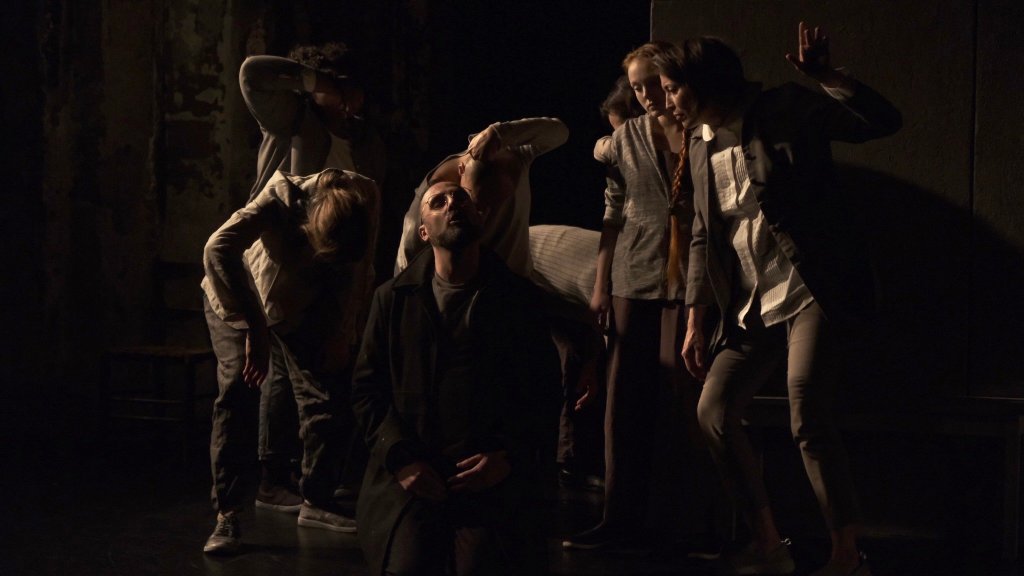
Anamnesis is a Challenging But Rewarding Experience at the Southern Theater

Photo by Dominique Serrand

The Dictionary defines Anamnesis as the remembering of things from a supposed previous existence. The play Anamnesis is not as easily defined. Certainly that definition of the term helps one to unlock some of the answers to the questions that we’ll ask ourselves at the end of the evening. Make no mistake, you will have questions and the play is not going to provide you with all of the answers. This isn’t an exercise in frustration, but you are going to need to make your own interpretations of what you’ve seen. This is not a play for everyone, if you like to be spoon fed your entertainment you might find this challenging. But, I would encourage those who have a little bit of curiosity to check it out. What is essential to the shows success is the way in which it uses humor to engage the audience. There are questions that will not be answered, what is with the blood? There are times at which you will feel somewhat lost, but they will be short lived and will add to the pleasure that comes from trying to wrap your head around what you saw and how you interpret it.

For me the key was the opening of the show, which opens on a darkened set draped by a large black tarp. The tarp is moving in a way that reminded me of the surf rolling up on a beach at night. From these waves one by one the cast appears, rolling out at first and slowly raising up to hands and knees then upright on two legs. They say that life on Earth began in the sea, and I read this as the creation of life. From there we follow the cast as they move around finally settling silently into chairs. Then they become aware of one another and slowly begin to embrace. Slowly they begin to talk and now they are a theater troupe rehearsing a play. But we will discover throughout that they are not just rehearsing the play but are also creating the play. The role of memory in the creation of the play is multilayered. There are the actors memorizing their lines. There is the role of memory in the story of the play they are rehearsing. There is the use of memories from the actors own lives that become part of the creation of this new play. There is the part memory plays when we have lost something and need to try and recreate it. For me the play is really about the role memory plays in the creation of art. How do we pass down memories from one generation to the next but by telling stories. This is my reading of what I saw and as such it holds meaning for me, but may not for you. This sounds heavy and confusing. That use of humor I spoke of is really important, it keeps this from becoming simply an exercise in interpretation for it is also entertaining. If you are confused by one section, don’t worry, the scene will change and you’ll find yourself on firmer ground again.

Anemnesis was conceived and written by Steven Epp, Nathan Keepers and Dominique Serrand and directed by Serrand. Epp and Keepers are also two of the cast, both exceptionally good among a cast of very talented performers. There wasn’t a weak performance in the entire show. Epp, gets to play the slightly slow on the uptake member of the troupe and as such, gets several of the best lighter moments. He also gets a chance to show a more serious side when he plays the part of the Messenger character in the play being rehearsed. Keeper gets to shine throughout with the other two standouts Jennifer Baldwin Peden and Masanari Kawahara, as they play the three main characters in the play within the play. Peden giving us a nice subverting of expectations with a “gasp”. Kawahara as the elderly mother suffering from dementia, who doesn’t always remember where she is or even who. He also shows a physical grace in several scenes that adds an unexpected beauty to the work. There is also spare but almost magical use of musical instruments and voice throughout that also heightens the entire work.

I see a lot of productions, one of the benefits of seeing so many shows is running across one like this from time to time. It’s exciting to find a show that you can really discuss afterwards. Not just in terms of whether you liked it or not, but really discussing what it meant. What makes this an especially fortunate find is that not only is it thought provoking but also entertaining. The show is produced by The Moving Company, it ran in late 2021 and was brought back in 2022, but has been beleaguered by covid forced cancellations. It was set to wrap after this weekends performances but has been extended for another week now running through Sunday February 6th. To purchase tickets click here https://www.southerntheater.org/shows/anamnesis

The Lakeshore Players in White Bear Lake with the Play “Clue”!

That’s my accusation for who can provide you with a murderously good time for 90 minutes in the theater this January. The play written by Sandy Rustin is based on the mid 80’s comedy film written by Jonathan Lynn and of course the classic Parker Brothers board game (currently published by Hasbro). Gathered together for a dinner party at a remote mansion on a dark and stormy night are the six Clue characters Col. Mustard, Miss Scarlet et al. Greeted by the staff Wadsworth the butler, Yvette the maid, and the cook, they are reminded to use the code names they were given on their invites to protect their privacy. After dinner they are invited to meet their host Mr. Boddy in the study, where he reveals that each of the guests is the victim of his blackmail scheme. He gives them each a gift in the form of a weapon, which if you’ve ever played the game you’ll be familiar with i.e the rope, the candlestick etc. He then tells them if they want to avoid having their blackmail amounts doubled, they need to eliminate the person who is blackmailing him. I won’t reveal who that is, but when Mr. Boddy turns out the lights, the killing begins.

That sounds dark and scary, but this is a very light comedy, you don’t have to worry about it being too scary for the tweens or too violent for Grandma. While this plays with the usual whodunnit murder mystery tropes, the main difference is that there’s really no chance or expectation that you’ll be able to figure out who did it. In fact, I’m not sure I even remember who did do it? That isn’t a criticism of the play though, it’s due to a fun technique used at the end in which we are given multiple solutions. I believe where it ended doesn’t account for one murder which we clearly see on stage who commits the crime. Does it matter? not a bit. Director Rose Schwietz gives us several cleverly staged sequences, the end reveals were my favorite of these. Another was the utilization of the rather elaborate sets, which allow for the creation of all the different rooms we are used to from the board game. In one sequence we watch a policeman go through two different rooms packed with characters while the stage hands slowly turn the set pieces giving us a sense that we are quickly moving through the room with the character. One sequence that it felt they never quite cracked was a much too long portion in the center of the play where the various characters are searching through the mansion. It was probably three minutes of people going in and out of doors that felt like ten minutes. There were a couple of interesting payoffs from open doors, but more was needed in this section to justify the time we spend on it.

The sets, lighting design, and sound design all worked well together. The soundscape created Matthew Vichlach from the beginning was particularly effective. With sound effects coming from different speakers in the theatre giving it a surround sound feel. One aspect that didn’t come off as well was the radio broadcast being played during the opening, it was too soft to glean any information from it which I believe was to try and set the time period in which the play was taking place. Shannon Elliott’s lighting was effective in creating the lightening for the storm and when possible drawing our attention to one section of the stage as another was being reset. The set pieces which I’ve already mention were quite versatile, the transitions sometimes taking a little longer than optimal but creating all these different rooms in a mansion on stage is a big ask, and the creativity outweighed the need for patience by the audience.

The cast does a nice job of nailing down their characters. These are not deep roles, but they require a surface layer that is distinct and allows the audience to grasp that character and be able to keep them firmly in mind as we are introduced to the next and the next. For me the standout performance was Derek Dirlam as Wadsworth the butler. Dirlam really committed to the zanier moments but also was the solid glue that held the story however tenuously grounded in some semblance of a reality. Of the classic six characters, the standouts were Theresa Rotter as Mrs. White, Chrissy Sonnek as Mrs. Peacock, and Craig Turino as Mr. Green. Turino sold his clumsy and subordinate character well, with well timed reactions and physical bits of comedy. While Rotter and Sonnek seemed like the most at home in their roles.

For more information and to purchase tickets to Clue click here https://www.lakeshoreplayers.org/clue-2022. The show runs through January 30th.

An Officer and a Gentleman at the Ordway

  • review updated please see not at bottom of the review.
Photos by Matthew Murphy for MurphyMade

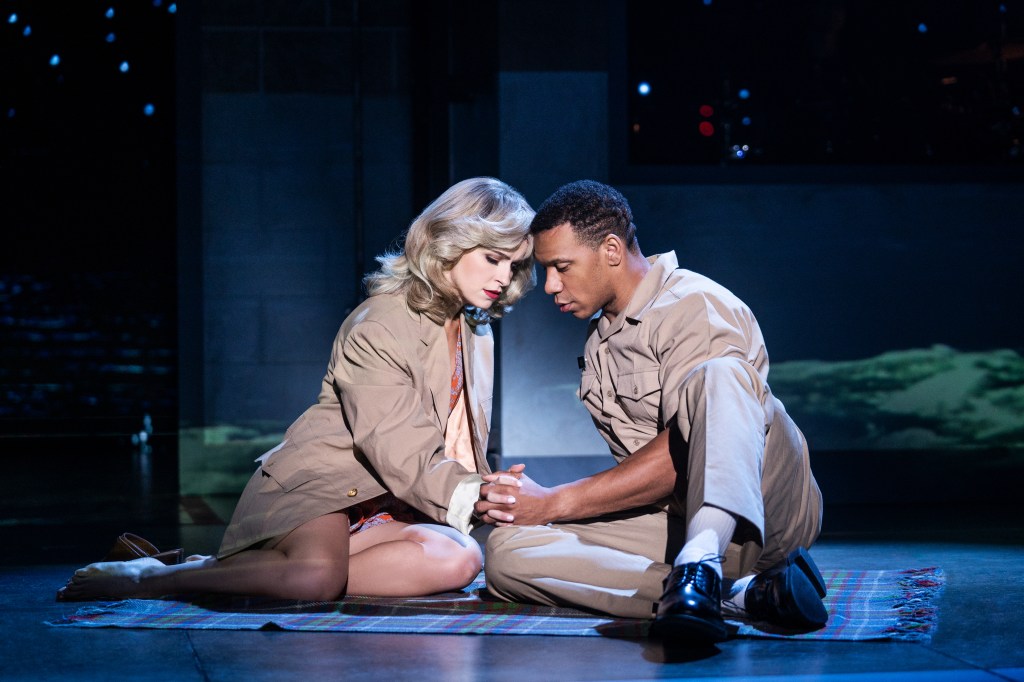
This is my first visit back to the Ordway since the Pandemic shut down theaters across the world. An Officer and a Gentleman is not a movie to musical adaptation that was on my radar. It is a Jukebox musical filled with classic 80’s pop songs. It follows the plot of the film but adds some twists to make the show more relevant while still keeping it set in 1981. We follow a class of Aviation Officer Candidates (AOC) from their first day through graduation. The main characters are Zack and Paula, he is a man with abandonment issues and a “me first” philosophy. She is a local girl who works in a factory while attending night school to become a paralegal. the other main couple is Zack’s roommate and fellow AOC Sid and the local girl he falls for Lynette who is looking for a naval officer to marry. It is with this couple that the musical diverges from the film by adding a twist that Sid in black and Lynette is White. It’s a nice change as it allows this secondary love story to address some real issues and also provides more diversity in the main cast.

In general the show adapted by Douglas Day Stewart from his own screenplay along with Sharleen Cooper Cohen keeps one entertained. It features some favorite 80’s songs “Never Surrender”, “owner of a Lonely Heart”, “Right Here Waiting”, “Lost In Your Eyes”, and of course the Oscar winning song from the film “Up Where We Belong”. The songs are integrated nicely into the story in most cases with one glaring exception. There is a medley of Pat Benatar songs that takes place during the AOC’s Battle games day. It seems shoehorned into the show, simply because the first song has “Battlefield” in its title. What the AOC’s are doing is well choreographed and interesting, but then on another portion of the stage there are three performers dressed in 80’s exercise outfits doing aerobics while singing the songs. The best of the songs are the quieter ones “Right Here Waiting” was a standout song by Mia Massaro as Paula and Roxy York as her mother Esther. York in particular shines here, creating what was the most emotional moment in the entire show. Emily Louise Franklin as Lynette and Cameron Loyal as Sid have a nice duet with “Lost in Your Eyes” Loyal really shows he has what it takes vocally on this song. The best voice on stage though was undoubtedly Amaya White who plays Casey Seeger, a female AOC who is trying to breakdown the barriers and become the first female AOC to graduate. Her talent is obvious every chance she gets to sing, especially on the song “Do the Walls Come Down”

Highlights of the show include the scenic design by Brett Banakis and the video design by Austin Switser. The set had multiple section that could be rotated to create different settings, most impressive was the centerpiece which rotated to show the wall that the AOC’s have to be able to climb to the top of during their physical training. The other side being used to for various other locations. The video projection was some of the best I’ve seen. It was used to both sell a change in location and also to set the mood. At times we’d see the surf rolling in on the beach at other times a giant sonar display used to help sell the montage like quality of the battle games sequence. *There was one egregious failure of the show unfortunately. The sound design was terribly miscalibrated. The Mics on the actors where turned up way to high, the Musicians were a little better, but they occasionally reached a level as well where you simply couldn’t differentiate what you were hearing it became a muddled mess. The softer songs were best, but frequently in the songs they have multiple performers all singing at once. Due to the extreme volume, it was just noise rather than song. Each voice indecipherable from the others rather than blending. Perhaps that is something they can adjust after opening night. Hopefully, because it is a very entertaining show with a lot of nostalgia going for it. The songs are great fun, but they need to find that balance so you can enjoy them.

An Officer and a Gentleman runs through Sunday at the Ordway Center for Performing Arts in Downtown St. Paul for more information and to purchase tickets go to https://ordway.org/events

*after this review was published I had communication with the Ordway theater regarding the sound issue. Due to some unexpected travel delays the company was rushed in order to get the show ready to perform for opening night. I’ve been assured that the remainder of the run will play with properly calibrated sound equipment. In my opinion the Ordway has superior acoustics to every other theater in town, I wish my schedule was open so that I could experience this show as it was meant to be heard.

World Premiere of Bina’s Six Apples at The Children’s Theatre Company.

Photos by Glen Stubbe Photography

Bina’s Six Apples is a play that from every aspect could be opening just as easily at the Guthrie theater as the Children’s Theatre Company. I say that as praise and a caution. This is a work that adults will find engaging and thought provoking. It does not play down to an audience of children. The recommended age for the show is nine years old and up, and I think it’s important for you to follow those guidelines. In addition, as a parent of a child who had sensory issues growing up, I would also caution that there are loud noises. In particular there a sequence of an extended tone that simulates the ringing in ones ears after an explosion. There is also a rather intense scene of a woman cruelly frightening a young girl. These are not criticisms of the content, simply a heads up to parents so you can make an informed decision as you best know what your children can handle.

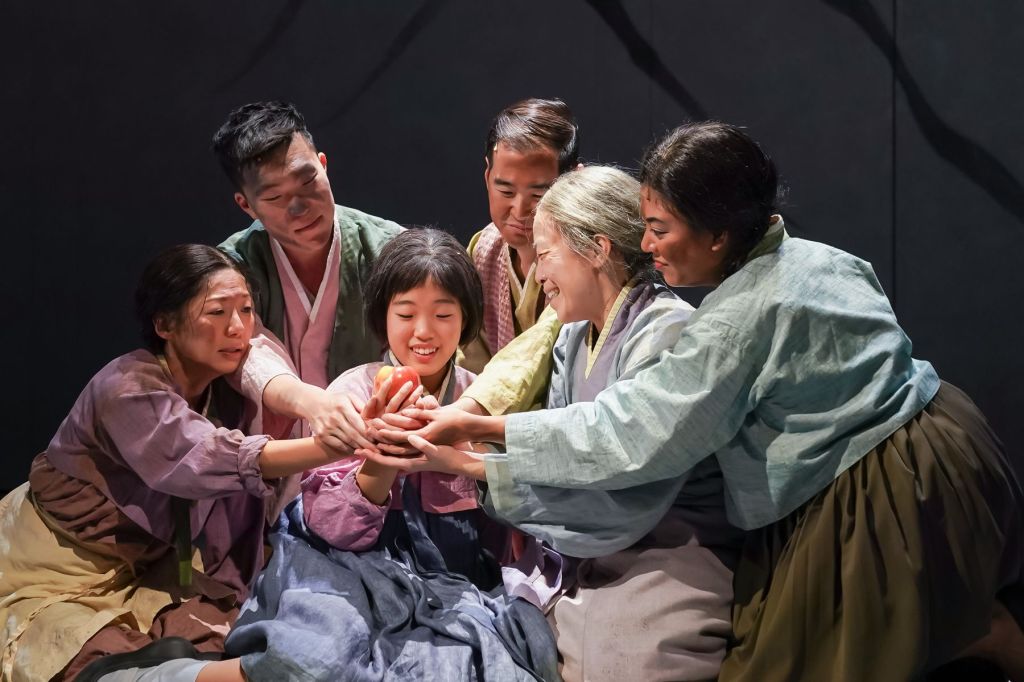
Bina’s Six Apples, a new play written by Lloyd Suh that is having it’s world Premiere at the Children’s Theatre Company. Suh was inspired by stories of his father and his family during the Korean War. Bina is a young girl growing up on her family’s apple orchard in 1950. Her family must flee as the war is coming closer, they need to journey on foot to Busan in the far southwest corner of Korea. Each family must carry what they can, Bina’s job is to carry six apples, all that she can fit in her backpack and her pocket. Early in the journey a bomb is dropped near the family and in the chaos Bina is separated from her family. The rest of the play follows Bina as she tries to get to Busan on her own with her six apples. While this is a story set during the Korean war, it functions for today’s audiences as an empathy gateway. Through Bina’s struggles we can gain a better understanding of what it must be like for the millions of people all over the world who have been displaced by conflicts or natural disasters. That’s a great jumping off point for parents and their kids discussion on the way home.

The cast is led by young Olivia Lampert who plays Bina, an amazing feat for someone so young. She has to play a range of emotions throughout and carry us along on this journey, which she absolutely does. There are six other members of the cast five of them play the members of her family and then also take on the roles of other people she meets on her journey. Two of the standouts were Shelli Delgado who plays among other roles a mother she meets along the way who is looking for her daughter. She is brutal to Bina in what must be a challenging role. Like this performance Elizabeth Pan plays Bina’s grandmother who also does not enact the childrens play version of a weary old woman. Both women play these roles very realistic and it adds to the impact and power of these sequences.

Director Eric Ting does some clever things in staging the show. As the family begins their journey we see them cross the stages slowly almost frozen in place as Bina stops and interacts with one set the others are almost frozen then she moves back like she is walking along a line of hikers conveying the sense that they were all still moving forward. The scenic and lighting designer Jiyoun Chang has created a set that continues to change, enlarge and reveal new surprises throughout the performance. It’s top notch work, minimalist yet simply elaborate greatly accented by lighting design, that at times echos reality and others blasts us with a broad burst to create an emotional punctuation.

Bina’s Six Apples is a powerful play about a specific moment in history through which we can all better understand the plights of our fellow human beings in today’s world. It is also a story of a young person persevering through a difficult journey, about learning responsibility, facing difficult things, and the importance of compassion. You really don’t need to have children to enjoy this play, perhaps the downside of it being performed at the Children’s Theatre Company is people will think of it as a play for young people. In fact, it’s a play that has multigenerational appeal. I hope it finds an audience with older theatregoers as well. Bina’s Six Apples runs through February 13th for more information and to purchase tickets go to https://childrenstheatre.org/whats-on/binas-six-apples/.