
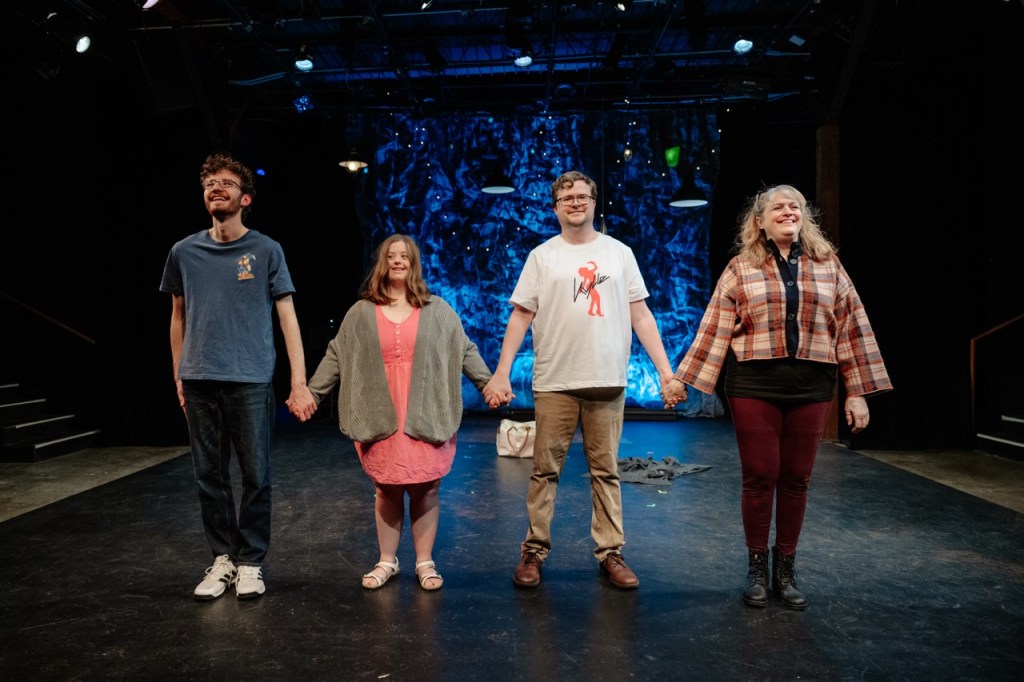
I’ve written before about Unlabeled Theatre Company, which produces theater with casts that include people with disabilities. Their shows have, until now, been musicals that pair adults 18+ with cognitive or physical disabilities with professional actors as shadow partners, performing the roles in unison. I feel I can never fully express how important what Unlabeled Theatre Company does is. Theater should be for everyone. It should reflect the infinite variables of our reality, it should allow for the telling of everyone’s story, and there should be a place for everyone to tell their own stories. Unlabeled Theatre Company takes it a step further and says everyone should be present and afforded the opportunity to tell any story. Someone who is neurodivergent or in a wheelchair should be able to play SpongeBob SquarePants or Nigel Bottom.
Jellyfish by Ben Weatherill is not only their first play, but it is also the U.S. premiere of this play. Weatherill stipulates that anyone who wants to license the play for performance must cast an actor with Down syndrome in the role of Kelly, a 27-year-old woman with Down syndrome. It is a limiting requirement, but a refreshing one. In doing so, Weatherill is undoubtedly sacrificing income in order to ensure that Kelly’s story is told by the right person. Representation is important. We say that over and over because it is true, and yet we constantly see examples where casting sidesteps it. I’ve loved the musicals that Unlabeled has done, not simply because of their mission, but because they have been well done. That is true of Jellyfish as well. This is an excellent script, and the production succeeds without needing any kind of disclaimer or qualifier. You shouldn’t come to an Unlabeled show as a good deed. You should go to see a show, and you should expect it to be everything any other show from a small theater company is.
Jellyfish is about a 27-year-old woman named Kelly who lives with her mother, Agnes. Kelly falls in love with a 32-year-old man named Neil. Kelly and Neil are happy together. They genuinely seem to get on well together, and the love is mutual. When Agnes discovers their relationship, she is furious and assumes that it is an exploitative relationship. Kelly has Down syndrome; Neil does not.
The play explores difficult-to-answer questions, and it’s telling that Agnes, who has been an advocate and caregiver for Kelly her whole life, is dead set against the romance. But why? Doesn’t every parent want their child to find love and be happy? How does that change when your child has a condition that involves even mild cognitive and developmental delays? Why does Agnes try to set up a date for Kelly with another man, Dominic, who is on the autism spectrum? Why, in her mind, is that an appropriate pairing, but Neil isn’t? Do we, on some level, understand her concerns? As the audience, we are shown the beginning of Kelly and Neil’s romance. We see that she is the instigator, that he is cautious, but that he also really likes her. We are given glimpses that allow us to be more accepting of the couple. But without that, would we also jump to the conclusions that Agnes does?
These are not easy questions, and there are no definitive answers. My first child, Alex, was diagnosed with Asperger syndrome, the same thing the character of Dominic is said to have in the play. Asperger’s is no longer a diagnosis that is used; it has since been merged into autism spectrum disorder (ASD). When your child has something, anything really, that makes them different, your gut reaction as a parent is to try and protect them, to worry about how they might be treated differently, and to worry that their options will be different from those without whatever it is that makes them different. Earlier this year, Alex got married. He is in Italy right now with his wife on their honeymoon. Now, a mild case of ASD is not the same as having Down syndrome. But my experience as a father, and having those impulses, particularly when Alex was younger, to try and protect him, does help me relate to Agnes on some level. But my experience as Alex’s dad now also helps me understand that differences and diagnoses don’t preclude people from wanting what every person has the right to want. Love, marriage, independence, even parenthood.
Maeve Linkert, who plays Kelly, is assisted by a shadow partner, Lisa Hanson. Unlike the traditional shadow partner process, Hanson does not act out the role with Linkert but is seated at the back of the stage and reads the lines along with her. Kelly is a big role, and I never had the sense that Linkert didn’t know the next line. I think Hanson was there for clarity of the line readings. The script is also projected on the wall to the side of the stage. In this case, to be honest, the shadow partner made it more difficult to hear the dialogue. I think we would have attuned our ears to Linkert’s line readings more easily if we weren’t trying to filter out Hanson as well. But it’s possible Hanson was there as reassurance for Linkert, too. As I said, Kelly is a big part, and if that was an accommodation Linkert needed, I’m glad she had it. By 15 minutes in, my ears had attuned, and if I ever missed a line of dialogue, I just glanced at the script projection.
What really impressed me about Linkert was her ability to bring out the humor of the play so effectively. There are a lot of dramatic moments, but the play is also very funny. It is in the extremes that Linkert is best. Her arguments with Agnes and a fight with Neil are powerful, and the light moments of humor are perfectly placed.
Shana Custer is a Stages of MN favorite, and it was great to see her tackle such a meaty role in Agnes. She invests Agnes with so many conflicting elements that it’s like she is a real person. Agnes is patient, Agnes is a fierce mama bear, Agnes is weary, Agnes is judgmental, Agnes is flawed, Agnes is real. Custer, always an effective comedian, is great with moments of humor. It’s the moments of confrontation and frustration that were the most enjoyable to watch, because we don’t often get to see Custer given the chance to play such a complex role as Agnes. I had no doubt she could do a role like this. We just don’t get to experience it that often, and she was so good at playing all these aspects of Agnes. Sounds like a great name for a band: Aspects of Agnes.
Joey Deegan, as Neil, has the very difficult role of playing someone not labeled with a diagnosis, though there are definitely hints of ASD (he reminded me a lot of my son Alex), who falls in love with Kelly. Deegan makes it clear to us that Neil is really in love, with no creep factor, which is exactly where Agnes jumps to. He has to convince us of their mutual attraction and of his character’s innate goodness, more so than in a traditional play, because we have to be on their side for the rest of the play to work. We have to believe these things in order not to lean toward Agnes’ alarm bells. Deegan is very good at playing off both women, creating a connection and a palpable sense of caring with Linkert while holding his own against Agnes, who is constantly attacking and threatening him. He comes off as the guy you want your daughter to meet, whether she has Down syndrome or not. Deeply good-hearted is a hard thing to project, but Deegan does it beautifully.
And finally, in a small but very fun role, Mason Green plays Dominic. His humorous line readings as he sits in Agnes’s living room waiting for his date with Kelly, who doesn’t know she’s coming, are great. They are the sort of honest, no-filter things that Alex has been known to come out with. Green feels just perfect in the role and is also very effective as a sounding board and friend for both Kelly and Agnes in later scenes.
The show is directed by Jessica Froehlich. It runs about two and a half hours long but doesn’t feel it. Jellyfish is an extremely good play, and given the requirements to perform it, this may be one of your only chances to see it. It raises a lot of thought-provoking questions and will make you reflect on and question your own responses. It’s also very entertaining and features strong performances by the whole cast. I highly recommend checking this one out, but it runs just one more weekend, so hurry.
Jellyfish runs through November 8 at the Gremlin Theatre in St. Paul. For more information and to purchase tickets, go to https://unlabeledtheatre.org/

Don’t forget to keep an eye on the new website 79 Seconds on Stage a free and full guide to local theatre in the Twin Cities.
Don’t rely on Facebook or Instagram algorithms to keep you in the loop about great shows. Subscribe and have every post from The Stages of MN delivered straight to your inbox. It’s the best way to make sure you never miss out on the theater action. To subscribe on a computer, enter your email address on the home page (right-hand side) and click subscribe. On mobile, scroll to the bottom of the page to find the same option. You can also follow me on Facebook @thestagesofmn and on Instagram thestagesofmn.

The Stages of MN YouTube channel is home to the Stages of MN Show. You can watch it by clicking here. Be sure to check out the latest episodes and subscribe so you’ll always know when a new one drops. Not sure you agree with one of my takes? I’m also part of the Twin Cities Theater Bloggers (TCTB), where you can find review roundups from my colleagues and me. Follow us on Facebook at @TwinCitiesTheaterBloggers.
Discover more from The Stages of MN
Subscribe to get the latest posts sent to your email.
