The trio behind the Mysterious Old Radio Listening Society (MORLS) Joshua English Scrimshaw, Eric Webster, and Tim Uren are bringing a special program to The Open Eye theatre in Minneapolis this week. Rattus Rattus is a Two Act show will consist of Act I “The Rats in the Walls” in which Tim Uren performs his acclaimed one-man show adaptation of the 1924 H.P. Lovecraft short story. Act II will be the trio in a brand new stage adaptation of the classic radio play and a personal favorite of mine “Three Skeleton Key”. I’m in love with this group, I’ve started getting into their podcasts as well which I highly recommend.
I have not seen, read, or listened to any version of “the Rats in the Walls” but it played to sold out houses at the 2006 and 2016 Minnesota Fringe Festivals so I’m excited for this experience. Three Skeleton Key is a classic radio horror story that I first heard in a college course. I have since listened to the recording via tapes and downloads and even got the chance in 2020 to hear see the MORLS perform it live at the Park Square Theatre. This I’m told, will be a new experience. There will be new scripts in from of Joshua, Eric, and Tim they will be performing the adaption as a play, with minimal set and props. If you’ve never heard “Three Skeleton Key” it’s a very creeping and suspenseful yarn.
Unlike their monthly Park Square gigs, where they do live performances of old radio scripts in the style of a radio show creating all of the sound effects and music in front of the audience, Rattus Rattus will be performed multiple times over the next two weeks.
Performing at Open Eye Theatre 506 East 24th Street, Minneapolis, MN
Friday June 10th Saturday June 11th Thursday June 16th Friday June 17th Saturday June 18th Showtime: 7pm
Sunday, June 12 Showtime: 2pm
For more information and to purchase tickets for Rattus Rattus go to http://ghoulishdelights.com/. You’ll find additional information there on another rat themed performance Reverend Matt’s Monster Science presents “Rat Kings”.
Zach Christensen, Courtney Matula, Ariel Pinkerton, Tony Burton. Photo by Roger C. Watts.
Wonderfully acted by a strong ensemble Perfect Arrangement is the perfect show to celebrate Pride. It reminds us how far we have come in terms of LGBTQ rights despite what feels like some steps backwards in recent years. Set in the 1950’s, it is a look back in time when being in the closet didn’t feel like a choice but a necessity. Opening like a 1950’s sitcom including built in commercials, the play grows darker and more real as it progresses. Opening with a look at the face, the characters show the world by the end we see all of them as they really are with their masks removed. Part historical, part satire, part drama, part comedy, within all of these parts runs a message about being your authentic self and how that is never as straightforward as it seems. Even by the end if you put yourself in the character’s shoes, you find yourself at a crossroads where ideals and reality intersect.
Written by Topher Payne Perfect Arrangement refers to the situation that the four main characters have set up for themselves. Bob and Millie are married and live next door in a duplex to their friends Jim and Norma. Bob and Norma work together at the State Department, Bob is the head of a team that has been looking for Communists within the U.S. Government. As the play opens the two couples are having a get together with Bob and Norma’s boss Theodore and his wife Kitty. During this opening scene, Theodore announces to Bob and Norma that they will be leading a new initiative to seek out and expose anyone who’s moral shortcomings could make them vulnerable to blackmail. This includes among other things, those who are homosexuals. As the scene plays out, the characters behave and speak as if they are on the Dick Van Dyke Show. Once Theodore and Kitty leave, the performances immediately become less stylized and one of the first lines of dialogue contains a certain four letter word that would never have escaped the lips of Rob and Laura Petrie. You see the perfect arrangement is that the couples have married each others lovers. Millie and Norma are the real couple who live in the this half of the duplex, Bob and Jim are lovers and live next door which they are able to move between through a closet that connects their two living spaces. For the rest of the play, Bob and Norma are tasked with doing their jobs without exposing themselves. When an affair from Millie’s past surfaces achieving these two paradoxal goals becomes more and more complicated.
All four leads are well cast with the standout being Courtney Matula as Millie. While not a complete natural with all of the comic bits, she captures the 50’s housewife facade perfectly and by the end she is the heart of the play. Ariel Pinkerton as Norma, gets to be the voice of outrage and conscience for the the foursome, and has some nice moments when she gets to vent her frustrations. Zach Christensen as Bob is the cool headed planner of the group, who does some ethical gymnastics in order to reconcile his personal and professional goals. Tony Burton as Jim seems to have the least to do and as such comes off as more or less a Bob’s trophy husband, albeit one that is kept in the closet. Alison Anderson does a nice turn as the easily confused and distracted Kitty, and Daniel Hildebrand as her husband, nicely vacillates between congenial and no-nonsense boss. Also quite strong in a smaller role is Katie Wodele as Barbara, a co-worker of Bob and Norma’s whose sexually free lifestyle has put her in the hot seat.
The show is well directed by Alissa Blaeser. She seems most adept at the satirical portions such as the opening scene and the dramatic moments such as the climax, and a little less sure in the broader almost slapstick or farcical passages. Lee Christiansen’s Set Design makes good use of the unique theatre in the round format and feels authentically period. The costumes by Colleen O’Dell felt very period correct as well and the gowns worn by Ketty, Norma, and Barbara as they head to the Opera were actually quite stunning. Lastly, I enjoyed the music by Sound Designer/Composer Robert Hoffman particularly the use of “I’m Coming Out” as exit music.
Don’t miss a single review from The Stages of MN, on your computer from the home page on the right enter your email address and click subscribe, on your mobile device scroll to the bottom of the page. Also Follow me on Facebook, search @thestagesofmn and click followand on Instagram thestagesonmn.
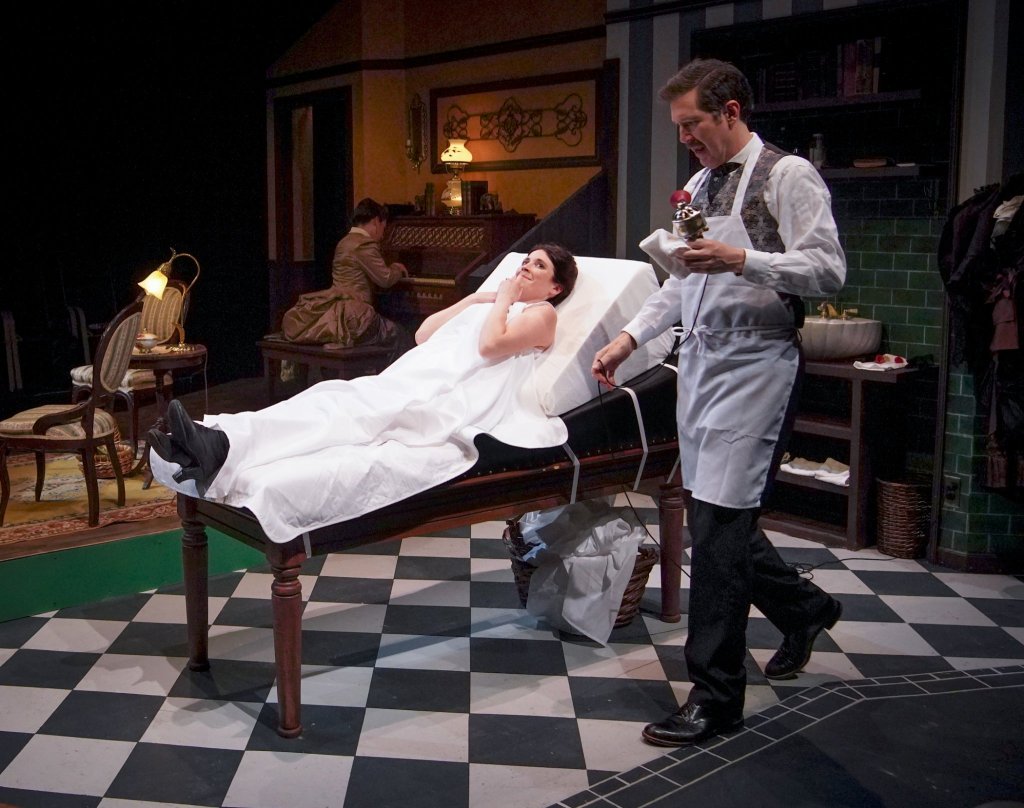
In the Next Room can easily claim more onstage orgasms than any other play this theatrical season. Honestly, probably any season. That said it’s more likely to be a hit with your mother than with anyone looking for something salacious. While there is no denying that the acts take place in full view of the audience they are still done with a sense of decorum that comes off as sweet rather than titillating. For anyone mature enough to attend the show, it’s billed as a comedy and there are plenty of laughs, but there are also real issues being discussed. Some of the biggest laughs come from some really sad truths about women’s sexuality at this time in history. Set in the latter part of the 19th century the play takes a look at the role of women as wives, mothers, and sexual beings through the lens of the early 21st century and the perspective is eye opening. From my opening line and the subject matter you might assume the humor comes from risque situations and mountains of double entendres, but it doesn’t. It comes when we recognize the truths laid bare under voluminous undergarments.
The play is written by Sarah Ruhl whose play Orlando I likewise reviewed favorably this past winter. Ruhl is a writer of considerable skill and uses it in the plays I’ve seen to question and examine gender roles while also entertaining her audience. The story is set in the house of Dr. Givings and his wife Catherine who have a newborn daughter but is unable to produce enough breast milk for. The set is divided into two rooms, the families parlor and the room next door which is the Dr.’s laboratory. The Dr. uses his invention to treat patients with electrical therapy who are suffering from hysteria, his invention is of course the vibrator. We are introduced to his new patient Sabrina Daldry who has been brought to the Dr. by her husband Dick Daldry, there’s a double meaning in that. Mrs. Daldry undergoes treatment from Dr. Givings assisted by his nurse Annie. After the treatment, in conversation the Daldry’s mention that their housekeeper Elizabeth has recently lost a child and it has been arranged that she will come and work as a wet nurse for the Givings. Dr. Givings is a man of science and has no issue with this arrangement but Catherine has reservations due to the fact that Elizabeth is black. Though it comes to light later on that Catherine’s issues seem to be more about not being able to provide for her child and in seeing her daughters emotional attachment transfer from her to Elizabeth. As Sabrina’s treatments continue, one thing becomes obvious that It’s much more effective in achieving the goal when Annie is in the room. Catherine becomes curious about this treatment her husband practices and wishes him to try it on her. One of the central themes of the play is the seemingly universal ignorance that the “Paroxysms” they are inducing are in any way related to female sexual gratification. Which is something, it’s revealed through conversation between the women in the play, they are unaware even exists. In the second act we are introduced to a new patient, this time a rare male patient, Leo Irving an artist. For this, Dr. Givings must use his “Chattanooga Vibrator” which stimulates the prostate gland. On meeting Mr. Irving, Catherine is attracted to his ability to express himself, something her husband has trouble doing unless he is discussing his fascination with electricity.
There are a lot of interesting characters and situations going on and Ruhl’s play contains enough ideas for two or three well rounded plays. It allows for a complexity to the characters that could easily be lost on a less talented cast. Emily Gunyou Halaas as Catherine has the most challenging role, she has to gain our sympathies while also displaying some characteristics that are unlikeable. She does an excellent job of showing us the frustrations she is feeling the sense of unfulfillment that every aspect of her home life entails. Paul de Cordova as Dr. Givings captures the enthusiasm of his characters profession while believably playing his cluelessness about his wives needs or the connection between his work and the intimacy she is longing for. As I alluded to before, the humor doesn’t come from one liners but from our understanding of our modern perspective of what the characters do not understand. All of the performers in the play excell at finding the perfect way to deliver that obliviousness without making their characters seem clueless all of the time. The supporting cast is each given moments to shine. Erin Nicole Farste as Elizabeth gets an actors dream scene where she describes how she has felt about her son’s death and nursing the Givings’ daughter. Laura Espingas as Annie has a beautiful and subtle moment with Adelin Phelps’s Sabrina that is heartbreakingly tender and seems like a moment that could have been the climax of a play all it’s own. Phelps pulls of what must be a very vulnerable task for an actor, having to perform the moment of orgasm multiple times during the run of the show. Do you play it for laughs, do you draw on your personal experience, how much are you going to share of yourself in those moments. However she achieved it, she found the perfect balance between finding the laugh, but also feeling somewhat realistic. Joel Liestman is cast as Mr. Daldry and it’s the sort of character role that he excels at. He’s given a wonderful comic moment when he tries to pose and make himself attractive to one of the other characters, which knowing these characters was never going to be successful. Finally James Rodriguez who doesn’t enter the play until the second half, perfectly portrays the sensitive and passionate artist as well as a gentleman, who has to go to a very vulnerable place onstage as well.
The production is directed with her usual sure hand Austene Van who seems to be everywhere at once these days. I feel like half the productions I see she is involved with in some way, and the other half should be so lucky. Sarah Brandner’s Set Design works really well in Yellow Tree Theatre Thrust stage configuration. We have a half door to show the wall between the the parlor and the Dr.’s laboratory, so we know clearly where the divide is but if you are seated to the sides of the stage the divide does not interfere with your view. I also really enjoyed the surprise set location that figures in the final scene which I won’t spoil but is well executed. Yellow Tree’s performance area is small and when the majority of the characters are on stage at once it does feel a little cramped, but I’d say Brandner and Van have done a good job with the design and blocking of keeping it from feeling unnaturally close. I also want to acknowledge the exquisite work of Costume Designer Samantha Haddow and Prop Master Julia Emery Cervera. The women’s dresses and underclothes seem authentic and the Dr.’s inventions are quite interesting and seem like plausible instruments for… well… you know.
In the Next Room, or the Vibrator Play runs through June 26th at Yellow Tree Theatre in Osseo MN. While I thoroughly enjoyed this play and find it funny and thought provoking it is not for all ages as you should assume. The theatre recommends it for high school aged and above, I’d error on the above side. It’s not that there is anything that is to inappropriate for high schoolers, I just think they may lack an understanding of the historical context and the life experience to fully appreciate the play. For more information and to purchase tickets go to https://yellowtreetheatre.com/next-room.
Don’t miss a single review from The Stages of MN, on your computer from the home page on the right enter your email address and click subscribe, on your mobile device scroll to the bottom of the page. Also Follow me on Facebook, search @thestagesofmn and click followand on Instagram thestagesonmn.
Greta Oglesby and Alison Edwards Photo by Dan Norman
Prime Productions is an interesting theatre company that focuses on providing roles for women over 50 on stage and behind the scenes. The Roommate is the perfect show for this company as it provides two juicy roles for it’s actors. The show will hit a chord with women of a certain age, but it’s appeal is not limited to any demographic. As a man of a certain age, I may not have been able to identify with every aspect of the characters but that doesn’t mean it didn’t connect with me. The circumstances of the characters are specific but most of the humor is universal. While I’d say this is definitely a comedy, it’s a little less straightforward than that, which is one of it’s many charms. But there’s no point in pretending that it’s biggest charm is anything other than it’s cast who are absolutely perfect in their roles.
Sharon played by Greta Oglesby is a divorced empty nester living in Iowa City, Iowa. Robyn played by Alison Edwards has just driven from New York, “the Bronx”, and is going to be Sharon’s roommate. The play opens on move in day when the women meet for the first time. The scene is filled with awkward moments as the women begin to learn about each other. We learn that Sharon is in a reading group, has a son who lives in New York who designs women’s clothing, and he is not gay, not that there’s anything wrong with that. Robyn is a vegan lesbian all of which catches Sharon off guard and makes her nervous. There is a lot of humor in the way they play this scene, but also an undercurrent of suspense. There are several clues in the scene that Robyn has secrets, that something is off. Edwards plays the scenes as if she is on edge throughout it, raising our suspicions but without tipping us to what her story is. It’s a fine line and Edwards walks it well, we don’t fear her, but we know there are secrets being kept. Oglesby takes the opposite approach telegraphing every emotion and thought which is the key to her character and to making the relationship dynamic work. Oglesby needs to let us into her character while Edwards needs to keep us out for the tension to work. As the women bond, Robyn will become more accessible. Sharon we are already onboard with and remain so as she goes through changes and tries new things. When Sharon discovers that Robyn smokes marijuana, she admits that she has never done anything like that. When they sit and try it together, its one of the best scenes and one in which Oglesby is clearly having a blast as are we the audience because we already feel like we know her. The characters together are what makes the play work, some of us will identify with Sharon, others more with Robyn but there is something we can recognize in each them. Personally, I’m a total Sharon.
The Roommate was written by Jen Silverman who has a real knack for writing the awkward getting to know you dialogue that is filled with humorous moments without ever feeling jokey. Sharon is so relatable and we warm to her so quickly because she sounds and behaves like a real person. Silverman writes Robyn with equal authenticity but as a completely different type of person. Sometimes in a comedy script that’s less developed, you can give characters each others lines, or jokes and no one will notice. Silverman’s writing is character specific, they each have their own distinct voices and their lines must be spoken by them or they will not work. Greta Grosch directs the play with some interesting decisions. One is the transitions between scenes, the lights go down and stage hands come on and remove or place props and help the actors to change costumes on stage. At first this seemed like an odd choice, but I quickly found it to be the best approach. None of the changes are that drastic, they move quickly and allow the next scene to start in a timely manner. Having the actors exit the stage, change, then re-enter and restart the play would have created a choppiness to the pace that would have worked against the show. I also thought the lighting choices by Grosch and Lighting Designer Grant E. Merges were a success. Frequently the lights would come up partially on a character highlighting them within the space for a moment and then come up on the rest of the stage as the scene opened up. I really like the Set Design by BrownKnows Design, particularly the window frame and ceiling molding that gives structure to the invisible back wall of the kitchen and dining room set.
The Roommate is at its heart a comedy but it isn’t just the female Odd Couple you might be expecting, it takes some unexpected turns, some really unexpected turns. I don’t want to spoil those surprises but it is worth pointing out that we completely buy those twists because of the skillfully comic and endearing performances by Greta Oglesby and Alison Edwards. The Roommate runs through June 19th at Mixed Blood Theatre for more information and to purchase tickets go to http://www.primeprods.org/.
Don’t miss a single review from The Stages of MN, on your computer from the home page on the right enter your email address and click subscribe, on your mobile device scroll to the bottom of the page. Also Follow me on Facebook, search @thestagesofmn and click followand on Instagram thestagesonmn.
I was originally supposed to attend the May 1st performance of Diary of a Wimpy Kid: The Musical but had to reschedule due to Covid. Usually for a Children’s Theatre Company production I would have a child as my companion so that I could get a sense of how the show plays to its target audience. Due to the rescheduling it ended up being my wife and I. The good news was that two of our kids were very into the Jeff Kinney books on which the show is based, so we were very aware of the source material and what appeals to its target audience. Some shows like Annie or Matilda can play on Broadway or the Children’s Theatre Company with equal success, others are best suited for the Children’s and similar venues. Diary of a Wimpy Kid belongs squarely in the later category and that’s perfectly fine. Its humor and storytelling is aimed directly at its target audience, and it hits a bullseye. Middle Schoolers are going to find a lot of what they like about Kinney’s books brought to life and the process experience the joys of live theatre.
Greg Heffley is beginning middle school and as it has happened for kids through the years, this is the point at which his priorities begin to change. It suddenly becomes more important to be popular, what we wear, and who we hang with begins to override just having fun and doing our own thing. The show follows Greg as he tries one plan after another to up his placement on the popularity ranking of his school. His attempts are thwarted over and over again by a multitude of sources. The show bounces around from segment to segment much in the vein of another staple of Children’s Theatre, You’re a Good Man Charlie Brown. While there is more of an overall story arc than there is in the Peanuts musical, it’s a very episodic show. This probably results in a more attentive audience as each new scene brings a fresh set up or adventure. The book for the musical by Kevin Del Aguila does a nice job of picking out favorite moments from the books series, in that way it’s a nice adaption.
The Music and Lyrics by Michael Mahler and Alan Schmuckler serve the show during its run-time, but like You’re a Good Man Charlie Brown, there’s not many songs that stick with you beyond the your time in your seats. The one possible exception is Animal Heart, which gains its own notoriety by refusing to end, but in a very humorous way. The lyrics are full of fun little jokes and as I say work within the show, but they are all too specific to have a life beyond the show itself. Like a production of that Charlie Brown show this production Diary of a Wimpy Kid, as well as future ones, will rise or fall on how well it is designed and directed. Jenn Thompson direction gets how to transition between short scenes that amount to a daily comic strip. Getting between these moments and keeping the show fluid is key and Thompson handles all of that perfectly. The Scenic Design by Scott Davis brilliantly captures the look of the books, using the design of lined journal paper as it’s motive. Carrying the lines paper look even into the cabinets in the Heffley family kitchen. The look of the show also cleverly utilizes projection which was designed by Edward T. Morris again helping to build that connection to the look of the source material.
The cast has alternate performers for the characters of Greg Heffley and his little 3 year old brother Manny. For the performance I saw Greg was played by Patrick McDermott and it was clear from the opening moments that despite his young age, he is at home on stage. There was none of the self consciousness we sometimes see in young performers, Mcdermott’s control of the stage and his singing voice made it clear he was the star. Kamryn Henderson plays Rowley, Greg’s BFFL (Best Friend For Life) is casting that seems ideal. Henderson seems born to play someone who knows how to be, or perhaps doesn’t know how, not to just be himself. For the image sensitive Greg this is a disaster. It’s to both McDermott and Hendersons credit that you empathize with both of them. We recognize Greg’s desire to stifle that which brings negative attention, but we also appreciate the beauty of being able to dance like no one else is around.
Diary of a Wimpy Kid: The Musical is not going to win over adults without children, unless they are adults who grew up on the books. But it’s going to be a great show for those about to enter middle school through high school. There are plenty of laughs for everyone and a very effective look to the show, for the right audience it will be a blast. For more information and to purchase tickets go to http://childrenstheatre.org/wimpy .
Don’t miss a single review from The Stages of MN, on your computer from the home page on the right enter your email address and click subscribe, on your mobile device scroll to the bottom of the page. Also Follow me on Facebook, search @thestagesofmn and click followand on Instagram thestagesonmn.
I’ve become a huge fan of this group and what they do. I’ve written several reviews in the past about their shows at Park Square Theatre in Downtown St. Paul. Mysterious Old Radio Listening Society (MORLS) performs live two classic radio scripts from the golden age of radio, do all of the voices as well as creating all the music and sound effects live in front of an audience. The problem with writing reviews of a show that will only be performed once is that you, the reader, don’t have a chance to read the review and decide to go see it. So I thought instead I will give you a heads up ahead of time so you have a chance to go buy tickets and attend the show. If you’ve never experienced a performance like this in the style of those old radio broadcasts you really need to check it out. I highly recommend these shows for families, including grandparents who may even remember listening to some of these very shows. It’s a unique opportunity to step back in time and show the younger generation what home entertainment used to look like. I think you’ll be surprised at how well they respond to something that seems so old fashioned.
Since the last performance of the MORLS that I attended I have begun listening to their podcast as well. You can find it wherever you listen to podcasts. In those shows they play an actual recording from an old radio show and then discuss it. the programs themselves run about 30 minutes and then they banter in a highly entertaining and humorous way for about 20 minutes about what they thought of the program and whether it stands the test of time. I’m really enjoying going through these podcast episodes and highly recommend them.
Upcoming productions of The Mysterious Old Radio Listening Society at Park Square Theatre:
Friday May 27th 7:30 PM – Legends of the Old West
“Death of a Picture Hanger” from Crime Classics (1953) – A true tale of the Old West told with wry wit and a sense of tragedy.
“Matt for Murder” from Gunsmoke (1954) – When Marshal Dillion is accused of murder, the governor sends another legendary lawman to Dodge City.
Sunday June 26th 2:00 PM – More Best of the Worst
“Battle of the Magicians” from Lights Out (1934) – What do magicians, airplanes, and zombies have in common? Absolutely nothing. But logic is no defense against this madcap mystical mash-up from the mind of legendary radio writer Wyllis “Quiet Please” Cooper.
“The Cup of Gold” from Dark Fantasy (1942) – A sports reporter’s investigation into the death of a golf pro leads to a series of shocking revelations! Scott Bishop’s murder mystery turned Surrealist manifesto will keep you guessing (or at least scratching your head) until the bitter, inexplicable end
go Park square theatre for tickets for in person or to stream from the comfort of your own home. Also for more information about these shows as well as an upcoming production at Open Eye Theatre of Rattus Rattus a double feature bill of Rat Centric Stories featuring the classic “Three Skeleton Key” and “The Rats in the Walls” go to http://ghoulishdelights.com/ .
Don’t miss a single review from The Stages of MN, on your computer from the home page on the right enter your email address and click subscribe, on your mobile device scroll to the bottom of the page. Also Follow me on Facebook, search @thestagesofmn and click followand on Instagram thestagesonmn.
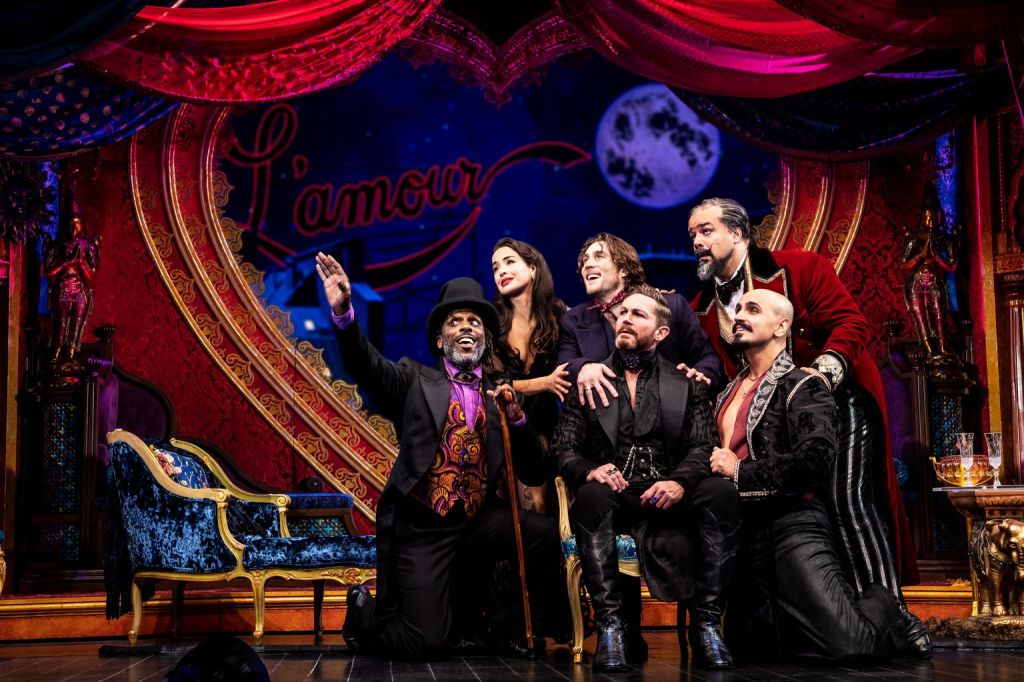
Moulin Rouge! The Musical is the stage adaptation of the 2001 film by Baz Luhrmann. The film is a favorite of mine and so with that in mind I was both excited and anxious to see this production. There are changes, addition and deletions. Most everything that was new I enjoyed, most of what was omitted I missed. The good news is that you are having such a good time that it isn’t until the walk to the car that you lament that they cut “Like a Virgin” and “One Day I’ll Fly away“. What you ask, could distract you from a missing Madonna song? Probably the most technically elaborate and beautiful production I’ve ever seen. From the moment you enter the theatre you know you are looking at a very expensive production. Before the performance even begins you are blown over by the beauty of the production design. Well at that point, you ain’t seen nothin yet! It makes sense that one of the most visually splendid movies since the turn of the century would also produce an equally spectacular stage adaptation. But underneath all the shine and glitter it is still a story about truth, beauty, freedom, and above all things a story about love.
The story follows Christian an american songwriter who has just arrived in paris. Within hours of his arrival he meets the artist Toulouse-Lautrec and his Argentinian friend Santiago whom he overhears trying to write a song. When he dazzles them with his lyrics they enlist him to pitch his songs to the star of the Moulin Rouge, Satine. If she likes his songs she well help convince the owner of the Moulin Rouge, Harold Zidler to produce the trio’s musical. They go to the Moulin Rouge where Satine mistakes Christian for the Duke she is trying to seduce so he will help Zidler financially, and perhaps elevate her in the world as well. Alone with Christian in her dressing room they fall in love with each other as he sings his song for her. Right before the Duke and Zidler arrive, the mix-up is discovered and to cover his presence, as well as that of Toulouse and Santiago, they convince the Duke that they are there to pitch him on the idea for their musical in hopes that he will finance it. He agrees but in exchange for his financial assistance he wants to own everything, particularly Satine. As the show is being rehearsed Christian and Satine carry on a secret love affair, but the Duke will not be fooled forever.
The songs within the show come from popular music, much of what we hear is new, songs that have come out since the film from artists as varied as Lady Gaga and Fun. But even the songs from the movie like the “Elephant Love Medley” and “Sparkling Diamonds” have additions that enlarge the smile already breaking across your face. Most of the newer music has saturated the popular culture enough that even I have heard of it. But there were a couple of additions that were not familiar such as the mashup of “Crazy” by Gnarls Barkley and “Rolling in the Deep” by Adele, but I’m certain I’m in the small minority on that front. That said even the musical moments that didn’t ring a bell worked within the story. I was always amazed at the perfection in blending lyrics from different songs into one that Luhrmann achieved in his film. The show carries on that tradition with nearly the same level of success. The additional material helps give the show a freshness and probably increases its accessibility to younger theatergoers who were either small children or unborn at the time of the films release. Hand in hand with the music goes the choreography by Sonya Tayeh which is stunningly good.
Speaking of stunningly good, the cast is just that. Top of the list is Conor Ryan, who showed incredibly range and gave a dynamic performance. One of the small issues I had with the production was that I felt his character went a little dark for too long towards the end of the show. But even in those instances when I felt the writing let him down, he didn’t let the writing down. Courtney Reed was good as Satine, though it felt like the songs were at times stretching her range a smidge. Austin Durant as Zidler was an audience favorite he was the perfect ringmaster for this group of bohemians. Andre ward’s Toulouse-Lautrec wisely chose not to attempt to mimic Lautrec’s diminutive stature, that would have been too restrictive. Ward adds a nice energy as the would be leader of the children of the revolution, adding a lot of humor in the conflict with the Duke over the content of the musical. A big round of applause to all the performers, their voices and movement were all integral to creating this breathtaking experience.
The highest of praise goes to the technical teams on this show starting with the set design by Derek McLane. The shows sets from the streets of Paris to the Moulin Rouge and Satine’s dressing room are gorgeous. The highpoint being the elephant Love Medley where we move from Satine’s dressing room to the clouds above Paris and the Eiffel Tower. Working in close synchronization is the spectacular lighting design and effects by Justin Townsend. Sometimes the lighting can go unnoticed if it’s done well with Moulin Rouge there is no way not to take note of the lighting because it is very showy but also perfect for this show. Costume design by Catherine Zuber is also a easily overlooked category, but again in this case they costume are so bold and beautiful that they cannot help but be noticed and admired. This is a rare show that wows us on every single element of the production.
Moulin Rouge! The Musical is play through June 5th at the Orpheum Theatre in Downtown Minneapolis. for more information and to purchase tickets go to https://hennepintheatretrust.org/
Don’t miss a single review from The Stages of MN, on your computer from the home page on the right enter your email address and click subscribe, on your mobile device scroll to the bottom of the page. Also Follow me on Facebook, search @thestagesofmn and click followand on Instagram thestagesonmn.
The Stages of MN
Stay informed with curated content and the latest headlines, all delivered straight to your inbox. Subscribe now to stay ahead and never miss a beat!







You must be logged in to post a comment.