Harry Potter and the Cursed Child Dazzles, Astonishes, and Wows! You Will Believe a Boy Can Wizard!

Adam Grant Morrison, David Fine, and Maren Searle Photo by Evan Zimmerman

First off, let’s deal with the Dementor in the room: the Dark Lord, J.K. Rowling. I struggled with whether or not to review Harry Potter and the Cursed Child. Faithful readers know that transgender issues are very important to me and my family. It’s one of the oldest conundrums in the world of art, can you still love and enjoy the art when the artist is revealed to be someone you cannot, in good conscience, support?

I own all the movies on Blu-ray, so as long as I don’t upgrade to 4K UHD, can I still watch and enjoy them, since I’m not adding any money to Rowling’s Gringotts vault? I love the Harry Potter books and films, and I really wanted to see the touring production of this Broadway show, but I was torn. I receive press tickets, so in that regard I’m not putting money in she-who-must-not-be-named’s pocket. But what about those who might read my review and decide to see it? I can’t just take the press tickets and then not review the show.

And what about the hundreds of people a tour like this employs, the actors, many of whom, if they’re just starting out or aren’t big names, don’t have the luxury of turning down a steady job? Doesn’t their work deserve to be acknowledged and praised or critiqued on its own merits? Then the rationalizations start to kick in, driven by that primal urge to see a favorite story continue, to find out what happens to characters I fell in love with a quarter of a century ago. Can the $5 or $10 that might go to Rowling from each ticket really matter at this point? Doesn’t she already have more money than she could ever need to spread her particular brand of ignorance? Probably. And yet, I was torn.

My fellow Twin Cities theater blogger over at Cherry and Spoon suggested that, even though our tickets were free, we could offset our attendance by donating the cost of those tickets to an organization that supports and protects the transgender community. So I’ve made a donation to Transforming Families equivalent to the full cost of the tickets.

Transforming Families is a Minnesota-based 501(c)(3) nonprofit that provides:

  • Monthly support groups for youth and caregivers
  • Educational and social events that build confidence and connection
  • Advocacy and outreach to create safer schools and communities
  • Family mentorship to help relocating families build supportive networks

When my son George first transitioned, we found answers and community through Transforming Families of Minnesota. At the time, the group consisted of maybe a dozen families gathering for peer-led support. Over the past decade, it has grown to more than 1,000 members. I offer this as a way to ease the guilt of any other Potterheads who can’t help but go to the show but feel conflicted.

Now, the review.

Harry Potter and the Cursed Child, pared down from its original two-part version (still running in London), is written by Jack Thorne, based on a story conceived by Rowling, Thorne, and John Tiffany. I had never read the script, though I believe someone in my family owns it. So I can’t say what’s missing from the extended version, which runs over five hours. What I can say is that, at just under three hours, this version absolutely flies by.

There’s a campaign called #KeepTheSecrets that urges audiences not to spoil the plot or its twists. There’s even a spoiler notice in the cast list asking audiences not to read it until after the show. So I’ll keep it simple: the story takes place 19 years after the events of Harry Potter and the Deathly Hallows. The children of Harry and Ginny, Ron and Hermione, and Draco Malfoy take center stage, but don’t worry, their parents are very much present and play significant roles.

But let’s be honest, what you really want to know is: how’s the magic?

It’s everything you want it to be and more.

There are effects I have no idea how they accomplished, and others where I can guess the technique, but they’re executed so flawlessly that they’re still astonishing. One effect, used whenever reality is distorted, makes the entire stage seem to ripple, as if the world itself is being rewritten before your eyes. I assume it’s some lighting or projection, but it looks uncannily real.

And it’s not all massive, mind-blowing spectacle. One of the most jaw-dropping moments happens right at the beginning: as the kids run toward Platform 9¾, the actors, dressed in ordinary street clothes, spin once and instantly appear in full Hogwarts robes. It happens in a fraction of a second. It’s completely unexpected and utterly magical.

Technically, every aspect of the production is flawless, with one minor exception. During a climactic wand battle, there appeared to be a glitch, the flames that should have appeared didn’t. It was a bit of a bummer (and forced me to rethink the photo I planned to use for this review), but honestly, the show is so dazzling that the moment barely registers. I suspect it will be fixed quickly.

Performance wise, the cast faces a daunting challenge. The films have left such an indelible impression of these characters that it’s hard not to compare. Still, I found myself adjusting fairly quickly. Ryan Hallahan felt a bit too jockish as Draco Malfoy, and Adam Grant Morrison was perhaps slightly too whiny as Albus Potter. On the other hand, David Fine is terrific as Scorpius, bringing warmth and humor to the role.

If you’re a Harry Potter fan, you’ll want to see this. It truly is magical. Ticket prices are a bit steeper than most shows, but you can see where the money goes, it’s all onstage, and it’s worth it for true believers.

But if you do go, please consider making a donation to Transforming Families. I know tickets are expensive, so even contributing the $5 or $10 that might otherwise go to Rowling per ticket would be a meaningful gesture.

Harry Potter and the Cursed Child runs through May 17 at the Orpheum Theatre in downtown Minneapolis. For more information and tickets, visit hennepinarts.org.

The Stages of MN delivered straight to your inbox. It’s the best way to make sure you never miss out on the theater action. To subscribe on a computer, enter your email address on the home page (right-hand side) and click subscribe. On mobile, scroll to the bottom of the page to find the same option. You can also follow me on Facebook @thestagesofmn and on Instagram thestagesofmn.

The Stages of MN YouTube channel is home to the Stages of MN Show. You can watch it by clicking here. Be sure to check out the latest episodes and subscribe so you’ll always know when a new one drops. Not sure you agree with one of my takes? I’m also part of the Twin Cities Theater Bloggers (TCTB), where you can find review roundups from my colleagues and me. Follow us on Facebook at @TwinCitiesTheaterBloggers.

Little Women Gets a Hugely Successful Adaptation at the Guthrie Theater

George Keller (Marmee), May Heinecke (Beth), Isabella Star LeBlanc (Louisa/Jo), Audrey Parker (Amy), and Stephanie Anne Bertumen (Meg) Photo by Dan Norman

Little Women has long been a favorite story of mine. I first experienced it in 1994 when I saw the film adaptation starring Winona Ryder in theaters. Since then, I’ve read the novel and seen other screen adaptations. But my only previous stage experience was the 2021 production at Artistry of Little Women: The Broadway Musical, which, frankly, was a disappointment. After that, I shied away from other stage versions, feeling that perhaps the theater just wasn’t the right venue for this story. Five years later, I decided to try again, this time with a non-musical adaptation at the Guthrie Theater. Why return? The script is by Lauren M. Gunderson, the most produced playwright in the country and the writer behind The Christmas at Pemberley trilogy, which follows characters from Jane Austen’s Pride and Prejudice, which are a personal favorite. (I’m still waiting for some ambitious theater company to mount all three plays in rep!)

So how does Gunderson’s adaptation compare to the Broadway musical? It blows it out of the water in every conceivable way. Gunderson uses the clever narrative device of having Louisa May Alcott herself tell the story. For those unfamiliar, Little Women is largely based on Alcott’s own life and her relationship with her three sisters. When the play opens, Alcott introduces us to her family, and then to their fictional counterparts. What’s beautiful about the story is how we follow the sisters and their relationships with each other and those around them. It feels very much in the vein of Jane Austen; you develop the same attachment to the characters, their misfortunes, and their joys. This is a story that thrives not on action or mystery, but on character.

Any adaptation of Little Women will succeed or fail largely on the strength of its cast. These are beloved characters, and audiences come in not just knowing them, but loving them. The cast here is sublime, led by Isabella Star LaBlanc as Louisa and, by extension, Jo. LaBlanc brings the perfect mix of confidence and intelligence. Her Jo has mischief in her eyes and secrets just beneath the surface. The moment that crystallizes her perfect casting is the look she gives the audience just before the blackout at the end of Act I. It can’t be described, it must be seen.

It’s also great to see Stages of MN favorite Daniel Petzold as Laurie. His strongest moments come in his interactions with Louisa; he’s particularly well suited to the show’s more meta elements, as well as the older, more mature version of the character. His younger moments feel slightly forced at first, but that fades as Laurie grows. The three sisters are equally well cast: Stephanie Anne Bertumen as Meg, May Heinecke as Beth, and Audrey Parker as Amy fully embody these beloved roles. A shout-out as well to George Keller, who is excellent as Marmee and delightfully comic as Aunt March.

As with most Guthrie productions, the set looks like a million bucks. Designed by Junghyun Georgia Lee, it’s a true stunner: an open grassy clearing surrounded by woods, with pieces of furniture scattered throughout. It supports the idea that we are watching Louisa and her sisters enact the story, rather than attempting strict realism. It’s a bold choice, and it works beautifully.

Fans of Little Women owe it to themselves to see this production. Like Theatre in the Round’s production of Pride and Prejudice last fall, it makes a story from another era feel fresh, immediate, and original.

Little Women runs through June 21st at the Guthrie Theater in Minneapolis. For more information and to purchase tickets go to https://www.guthrietheater.org/whats-on/little-women/

The Stages of MN delivered straight to your inbox. It’s the best way to make sure you never miss out on the theater action. To subscribe on a computer, enter your email address on the home page (right-hand side) and click subscribe. On mobile, scroll to the bottom of the page to find the same option. You can also follow me on Facebook @thestagesofmn and on Instagram thestagesofmn.

The Stages of MN YouTube channel is home to the Stages of MN Show. You can watch it by clicking here. Be sure to check out the latest episodes and subscribe so you’ll always know when a new one drops. Not sure you agree with one of my takes? I’m also part of the Twin Cities Theater Bloggers (TCTB), where you can find review roundups from my colleagues and me. Follow us on Facebook at @TwinCitiesTheaterBloggers.
Ada Lovelace: Bride of Science is the Most Interesting Math Lesson You’ll Ever Get

Ada Lovelace: Bride of Science

Ada Lovelace: Bride of Science is the first full-length play written by Stages of MN favorite Nissa Nordland. I’ve enjoyed Nordland’s writing in her short-form plays featured at the Twin Cities Horror Festival and Minnesota Fringe Festival. I’ve loved those shows, but anyone familiar with those festivals knows that kind of work is unique. I was excited, but also a bit anxious, to see what she would do with a full-length play. After all, I promise Minnesota honest reviews, and being a favorite doesn’t grant immunity from criticism. I’m relieved to report that I came away impressed by the discipline of the piece, which is without a doubt a polished, effective, and creative telling of the story of real-life mathematician Ada Lovelace.

Lovelace, the daughter of the poet Lord Byron, was a woman ahead of her time. Considered the first computer programmer, she died in 1852 at the age of 36. Knowing Nordland’s affinity for the dark side, I suspect the title is a play on The Bride of Frankenstein, especially given that Ada’s father, Lord Byron, figures into the origin of Mary Shelley’s famous tale. Ada does seem to share with Victor Frankenstein a single-minded obsession in her pursuit of, at a stretch, an artificial form of life.

We follow Ada’s story from her parents’ separation when she was one month old through her death. Along the way, we witness her relationship with her overbearing mother, her marriage to William King-Noel, 1st Earl of Lovelace, and her own challenging relationship with her children. But the two most important relationships are with her dead father, who emerges from a painting to converse with and encourage her, and with Charles Babbage, fellow mathematician and inventor of the Analytical Engine, which would have been the world’s first computer if it had been completed. Ada could see the potential of the Analytical Engine beyond what even Babbage could, and far beyond what the rest of the world, unable to imagine its use, could grasp.

Gabi Jones, who is relatively new to me, does a great job handling the highly technical dialogue while also conveying Ada’s “poetical science” approach to her work. Derek Lee Miller, as both Lord Byron and William King-Noel, is excellent as always. I especially loved his take on the dead Lord Byron, including a song he sings to Ada that is particularly well done. Tara Lucchino, as Ada’s mother, does not shy away from the character’s cruelty, but also allows her softer side to come through. David Tufford capably handles some truly challenging technobabble, but his best moments come in conflict with Ada toward the end, as well as in scenes with her fellow mathematician and friend Mary Somerville, played by Victoria Pyan. Pyan excels in scenes addressing what she sees as Babbage taking advantage of Ada’s intellect without giving her proper credit.

Lastly, praise must be given to scenic designer Ursula K. Bowden for a surprisingly large scale set full of inventive touches, including a computer punch card flat that scrolls to display the year as the play progresses. Director Josh Cragun also deserves recognition; his use of movement creates an almost dreamlike quality in scenes that primarily serve to deliver exposition or endnotes, transforming what could be dry information dumps into elegantly engaging interludes.

Ada Lovelace: Bride of Science runs through April 19 at the Crane Theater in Northeast Minneapolis. For more information and tickets, visit https://nimbustheatre.com/productions/ada-lovelace

The Stages of MN delivered straight to your inbox. It’s the best way to make sure you never miss out on the theater action. To subscribe on a computer, enter your email address on the home page (right-hand side) and click subscribe. On mobile, scroll to the bottom of the page to find the same option. You can also follow me on Facebook @thestagesofmn and on Instagram thestagesofmn.

The Stages of MN YouTube channel is home to the Stages of MN Show. You can watch it by clicking here. Be sure to check out the latest episodes and subscribe so you’ll always know when a new one drops. Not sure you agree with one of my takes? I’m also part of the Twin Cities Theater Bloggers (TCTB), where you can find review roundups from my colleagues and me. Follow us on Facebook at @TwinCitiesTheaterBloggers.

Hmong Futures: The Future of Us A World Premiere From Theater Mu.

The full cast of “HMong Futures: The Future of Us” Photo by Rich Ryan

Hmong Futures: The Future of Us is the new play by Katie Ka Vang, having its world premiere from Theater Mu. It’s the story of three generations of a Hmong American family a mother, daughter, and granddaughter. It is, to be sure, a story about family, but also about community, or our found families.

Fhoua comes to the home of her mother, Zong, whom she hasn’t spoken to in five years. We learn from a phone call with her own daughter, Maly, who is away at camp, that she has something difficult to ask her mother. We suspect she wants to ask if they can stay with her. There is a lot of information we are not privy to at first, which is gradually revealed. That withholding mirrors a key theme of the play: these characters don’t speak openly about important things, and the script reinforces that by keeping certain details from us.

The secrets matter, of course, but the real thrill of the production, and where Katie Ka Vang truly excels, is in the voice of the characters. Their exchanges, their frustrations, all ring true. The way they talk around issues, saying one thing while meaning much more than they verbalize, feels authentic and deeply observed.

The cast is fantastic at making the dialogue feel natural while conveying the unspoken meaning beneath it. Sharon Omi, as Zong, is excellent as a mother shaped by a different country and a more survival driven life. Nancy Ma is stunning as Fhoua, a woman so accustomed to avoiding conflict that she struggles to reconnect with her mother and seems ready to slip away again. Melody Her, as the 16-year-old Maly, is one to watch. This is my second time seeing Her perform, the first was in Again, also by Vang, with songs by Melissa Li, which I loved, particularly Her’s performance. A college graduate, she can still convincingly play a teenager without it ever feeling forced or artificial.

Rounding out the cast is Greg Watanabe as Unclefriend, a very funny role and part of the found family Zong has built. Mason Yang appears as Aben, a young man helping out in the cooperative Zong is part of and also staying with her. He is also 16, and he and Her share a nice scene in which they open up to each other about their family situations.

A final note on the set design by Sarah Bahr. The set places the interior of Zong’s house upstage, with her garden downstage. The characters actually garden at various points, and it beautifully blends their inner lives with their connection to nature and farming. It’s a wonderful achievement and an impressively executed design.

Hmong Futures: The Future of Us runs through May 3rd at the Gremlin Theatre in St. Paul. For more information and to purchase tickets, visit https://www.theatermu.org/hmong-futures#gsc.tab=0

The Stages of MN delivered straight to your inbox. It’s the best way to make sure you never miss out on the theater action. To subscribe on a computer, enter your email address on the home page (right-hand side) and click subscribe. On mobile, scroll to the bottom of the page to find the same option. You can also follow me on Facebook @thestagesofmn and on Instagram thestagesofmn.

The Stages of MN YouTube channel is home to the Stages of MN Show. You can watch it by clicking here. Be sure to check out the latest episodes and subscribe so you’ll always know when a new one drops. Not sure you agree with one of my takes? I’m also part of the Twin Cities Theater Bloggers (TCTB), where you can find review roundups from my colleagues and me. Follow us on Facebook at @TwinCitiesTheaterBloggers.
Conscience at Theatre in the Round is a Powerful Yet Entertaining Reminder of How Far We Have Fallen

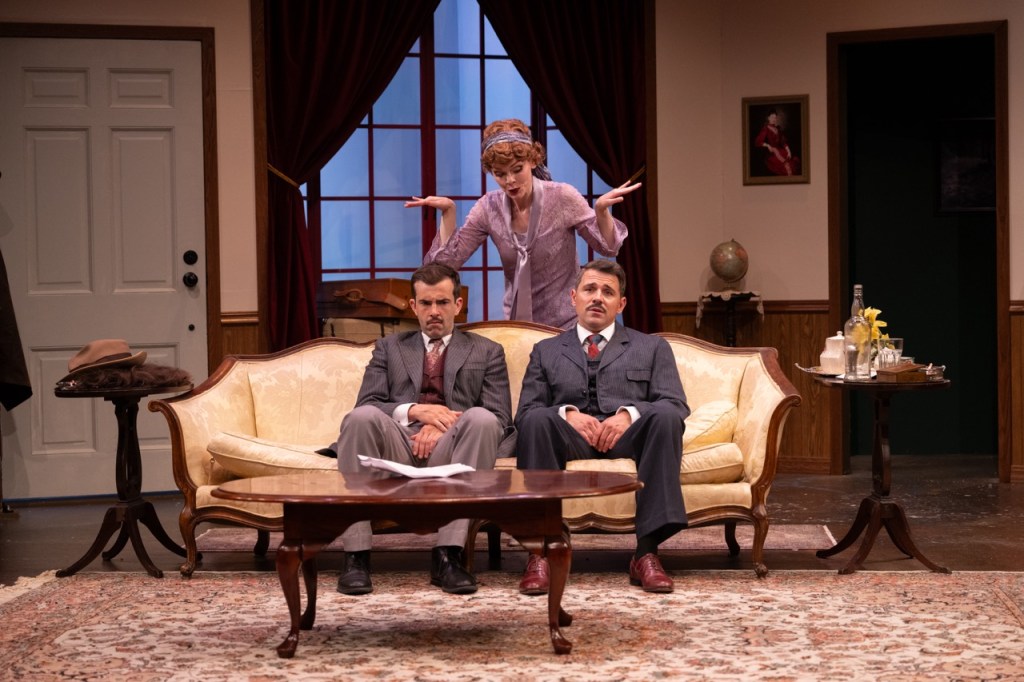
Mary Lofreddo, Ron Lamprecht, and Alison Anderson Photo by Tom Taintor

You can’t spell conscience without science. Perhaps that’s why so many MAGA supporters seem to lack one, because they reject the other. Scientific truths become “alternative facts,” and when elected Republicans stayed silent as that phrase was first trotted out, they effectively endorsed it.

Conscience, by award-winning playwright Joe DiPietro, tells the true story of the first woman to serve in both houses of the U.S. Congress. In 1950, as a Republican senator from Maine, she delivered a speech on the Senate floor known as the “Declaration of Conscience,” openly condemning the tactics of fellow Republican Senator Joseph McCarthy. This came at a time when Congress was paralyzed by fear, fear of crossing McCarthy and becoming the next target of his reckless accusations.

In that speech, she warned that such tactics would debase the Senate to “a forum of hate and character assassination,” while defending every American’s “right to criticize… the right to hold unpopular beliefs… the right to protest; the right of independent thought.” She also made clear that while she wanted Republican success, “I don’t want to see the Republican Party ride to political victory on the four horsemen of calumny—fear, ignorance, bigotry, and smear.” Sound familiar?

The play does an excellent job dramatizing Margaret Chase Smith’s campaign to stand up to one of the most dangerous figures in American political history. It doesn’t need to force modern parallels, they are sitting in plain sight. By remaining firmly rooted in its historical setting, the play becomes even more chilling. We’re often told we study history so we don’t repeat it. If that’s true, the present moment suggests we haven’t been paying attention.

The play features four characters, all portrayed by excellent performers. Alison Anderson brings intelligence and quiet moral authority to Margaret Chase Smith, while Ron Lamprecht captures the bluster, buffoonery, and menace of Joseph McCarthy. Despite the gravity of the subject matter, the play is often surprisingly light and frequently funny, again, trusting the audience to draw its own connections rather than forcing them.

The remaining roles are equally strong. Mary Lofreddo plays Jean Kerr, McCarthy’s assistant and eventual wife, while Tim Wollman portrays William Lewis Jr., Smith’s loyal advisor, who is also a closeted gay man, another group targeted during McCarthy’s crusade. The strength of these performances is a major reason the show succeeds not only as a history lesson, but as compelling entertainment.

Directed by Sophie Peyton, the production runs just under two hours with an intermission. I’ll admit, I’m often skeptical of intermissions in shows that could run straight through, but in this case I welcomed it. I actually spent much of the break jotting down thoughts from the first act. I also want to highlight Sadie Ward’s set design, which features elements resembling torn fragments of the Constitution, an evocative visual metaphor that complements the play’s themes.

Near the end, the play recalls Joseph Welch’s famous rebuke to McCarthy: “Have you no sense of decency, sir, at long last? Have you left no sense of decency?” It’s a line that still resonates, perhaps now more than ever. It’s hard not to think of how rarely that standard seems to apply today. For instance, consider a recent Truth Social post from Donald Trump about Bruce Springsteen:

“Bad, and very boring singer, Bruce Springsteen, who looks like a dried-up prune… has long had a horrible and incurable case of Trump Derangement Syndrome… The guy is a total loser… MAGA SHOULD BOYCOTT HIS OVERPRICED CONCERTS, WHICH SUCK. SAVE YOUR HARD EARNED MONEY. AMERICA IS BACK!!! President DJT”

Those are the words of a sitting president, expressed while the country faces far more serious concerns. The lack of decorum is striking, and it’s difficult not to draw comparisons to McCarthy’s own crass and reckless rhetoric. It’s hard to imagine many other presidents speaking this way with such frequency. Which brings to mind Mike Judge’s film Idiocracy. When it was released in 2006, it felt wildly over-the-top, a broad, absurd comedy. Nearly twenty years later, it doesn’t seem quite so far-fetched. What once felt like satire now lands a little too close to reality.

I’ll leave you with one final quote from Smith’s “Declaration of Conscience”: “It is high time that we all stopped being tools and victims of totalitarian techniques—techniques that, if continued here unchecked, will surely end what we have come to cherish as the American way of life.”

Conscience is the kind of production that feels essential. Theatre in the Round has been having an exceptional season, and this is another strong entry that deserves a wide audience. Conscience runs through April 19th at Theatre in the Round in Minneapolis. For more information and to purchase tickets go to https://www.theatreintheround.org/conscience/

Don’t rely on Facebook or Instagram algorithms to keep you in the loop about great shows. Subscribe and have every post from The Stages of MN delivered straight to your inbox. It’s the best way to make sure you never miss out on the theater action. To subscribe on a computer, enter your email address on the home page (right-hand side) and click subscribe. On mobile, scroll to the bottom of the page to find the same option. You can also follow me on Facebook @thestagesofmn and on Instagram thestagesofmn.

The Stages of MN YouTube channel is home to the Stages of MN Show. You can watch it by clicking here. Be sure to check out the latest episodes and subscribe so you’ll always know when a new one drops. Not sure you agree with one of my takes? I’m also part of the Twin Cities Theater Bloggers (TCTB), where you can find review roundups from my colleagues and me. Follow us on Facebook at @TwinCitiesTheaterBloggers.

Great Falls is Dark and Powerful, With Two Very Strong Performances at The Hive

Great Falls, by Minneapolis native Lee Blessing, is a heavy show about a road trip between a teenage girl and her stepfather. It opens in a way that immediately makes the audience uneasy, as it quickly becomes clear that the stepfather, whom she calls Monkey Man, is divorced from her mother. That, in itself, is fine; I firmly believe people divorce spouses, not children. But it’s also clear she does not want to be with him. We’re not entirely sure what’s happening at first, but it all feels very sketchy. The play tackles a number of difficult themes, including abuse and sexual assault.

Luckily, there are two very strong performances, by actors I don’t believe I’ve seen before, to guide us through the darkness. Andy Chambers plays Monkey Man, somehow making dialogue that could feel untethered from reality, particularly early on, seem plausible, if still a bit opaque. I think Blessing wants us to feel off-balance, unsure of what’s happening and why. Honestly, I’m not sure we ever fully understand that part. I mean, we do, but what is wrong with this man that he thinks this is an appropriate way to stay connected to Bitch (which is what she insists on being called)? He keeps insisting he’s not committing any crimes, but he absolutely, technically, is.

Reanna Madson plays Bitch, and as the stepfather of a girl who is shockingly similar (thankfully without the trauma), I can say her performance feels very genuine. Whether she’s being difficult and combative or delivering difficult information, she is never anything but truthful. The two play well off each other, with Chambers perfectly capturing the challenge of trying to start a real conversation, and Madson’s character stubbornly refusing to give him any foothold.

Directed by local actor, lighting designer, and jack-of-all-trades Ariel Pinkerton, the show benefits from her understanding of the material and its triggers. She handles the subject matter with care and clarity.

The set design by Keven Lock is both a strength and a weakness. The production gets a lot of mileage out of two platforms that cleverly transform into everything from the dashboard of a car to motel beds, a clinic, and several other locations. Clever projections by Alita Robertson, especially during the driving sequences, enhance the sense of distance and movement. The downside is a series of slightly overlong scene transitions, where we sit in darkness watching the performers reconfigure the set.

Great Falls runs through April 5th at The Hive Collaborative in St. Paul. For more information and to purchase tickets go to https://www.thehivecollaborativemn.com/events/7b0cg7xhh7bw5zknaa144n9ti7kdkk

Don’t rely on Facebook or Instagram algorithms to keep you in the loop about great shows. Subscribe and have every post from The Stages of MN delivered straight to your inbox. It’s the best way to make sure you never miss out on the theater action. To subscribe on a computer, enter your email address on the home page (right-hand side) and click subscribe. On mobile, scroll to the bottom of the page to find the same option. You can also follow me on Facebook @thestagesofmn and on Instagram thestagesofmn.

The Stages of MN YouTube channel is home to the Stages of MN Show. You can watch it by clicking here. Be sure to check out the latest episodes and subscribe so you’ll always know when a new one drops. Not sure you agree with one of my takes? I’m also part of the Twin Cities Theater Bloggers (TCTB), where you can find review roundups from my colleagues and me. Follow us on Facebook at @TwinCitiesTheaterBloggers.
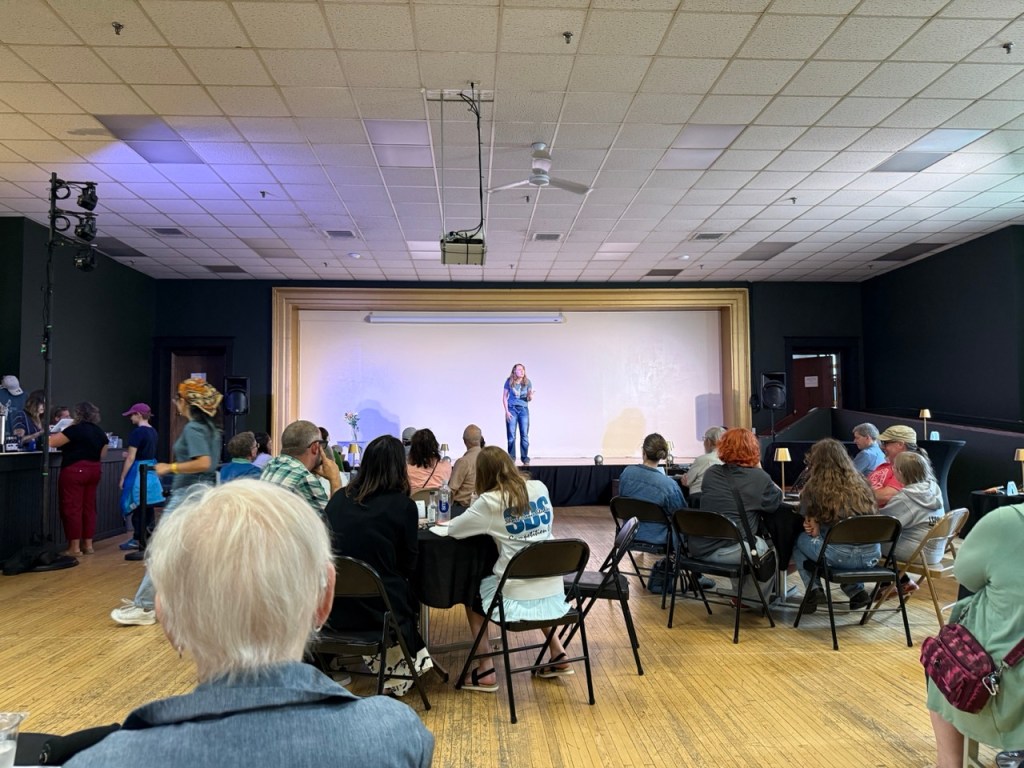
Abuelita From Prime Productions Needs More Time To Tell its Characters Stories.

The cast of Abuelita Photo by Dan Norman

Prime Productions closes out its 8th season with the world premiere of ABUELITA, a new play by Nathan Yungerberg. There is a lot of good stuff here, but there also seem to be many threads that don’t really lead anywhere. What this material feels ideally suited for is a TV series. There are seven great characters, and four of them get about one scene in which to shine, when they are clearly interesting enough to hold our interest for dozens. In its present form, it feels like there are three characters too many, or perhaps three who are given stage time that should have gone to others, so that more of them could fully realize their roles in the story.

The play opens with Davia, a 72-year-old white grandmother from Iowa who has moved to Spanish Harlem in the summer of 1993 with her fifteen-year-old mixed-race grandson, Jesús, to expose him to his father’s Puerto Rican culture. They meet the other residents of their apartment building on the stoop when they arrive. Davia and Yvette quickly bond over being grandmothers raising grandchildren who have lost their mothers, getting drunk on some sort of alcohol Yvette smuggled back from her last trip to Puerto Rico. Yvette’s granddaughter, Sonya, and Jesús become friends, and she introduces him to her group, some of whom are gay, as we learn Jesús is as well. Davia, in turn, begins to find companionship with Yvette, her sister Indigo, and Wilfredo, a bongo-playing singer who lives next door.

It’s hard to escape the feeling that many of these interactions play like the first of what should be many scenes, or like the third scene, with the previous two missing. Davia is a great character, but almost every moment with her feels like it needed more room to breathe and develop. I also don’t think the character was helped by Mary Gant’s performance; there were simply too many missed or flubbed lines. There is real potential here, but Gant doesn’t quite convey the nuance the role requires. Or perhaps the issue lies more in the script, which rushes toward “aha!” moments that would land more effectively if the relationships had time to grow and unfold.

There are, however, several very enjoyable performances. Skyler Seiler as Sonya is sassy and fun. King Jackson as Jesús starts out somewhat awkwardly, but that seems to be a deliberate choice that tracks with the character; as he becomes more comfortable in his new environment and freer to be himself, the performance comes alive. Pedro R. Bayon is very good as Wilfredo, though he’s another character who gets one strong scene and little else to do, despite feeling like someone you’d want to follow further. Gabi Del Moral as Yvette is also very good, though her relaxed, fluid performance only highlights Gant’s relative stiffness, and their instant friendship doesn’t quite feel earned. Adlyn Carreras as Indigo has a few line flubs as well, but her swagger and attitude carry her through them more successfully. Like others, Indigo feels like a character with much more story to tell. And since I’ve mentioned everyone else, I should note Elsa Vega Pérez as Niego, who is apparently related to Yvette and Indigo, though it’s not entirely clear how. She has only a few lines in Spanish before disappearing for a stretch and then briefly reappearing. She’s good, but likely the first character to cut if tightening the piece.

Ultimately, I’d happily watch these characters for 10 or 12 hours a year. If this play were the first season of a TV series, the ending we see here would probably land around episode six. It’s not that the play is bad, it’s one of those cases where you can clearly see its potential to be something more, and it’s hard not to focus on that. Most plays are easy to take as they are: good, bad, or somewhere in between. But every once in a while, you encounter something that so clearly should be, not different, just more. These characters don’t need better writing; they simply deserve more of it.

ABUELITA runs through March 29th at the Capri Theater in Minneapolis. For More information and to purchase tickets go to https://www.primeprods.org/abuelita

Don’t rely on Facebook or Instagram algorithms to keep you in the loop about great shows. Subscribe and have every post from The Stages of MN delivered straight to your inbox. It’s the best way to make sure you never miss out on the theater action. To subscribe on a computer, enter your email address on the home page (right-hand side) and click subscribe. On mobile, scroll to the bottom of the page to find the same option. You can also follow me on Facebook @thestagesofmn and on Instagram thestagesofmn.

The Stages of MN YouTube channel is home to the weekly Stages of MN Show. You can watch it by clicking here. Be sure to check out the latest episodes and subscribe so you’ll always know when a new one drops. Not sure you agree with one of my takes? I’m also part of the Twin Cities Theater Bloggers (TCTB), where you can find review roundups from my colleagues and me. Follow us on Facebook at @TwinCitiesTheaterBloggers.