
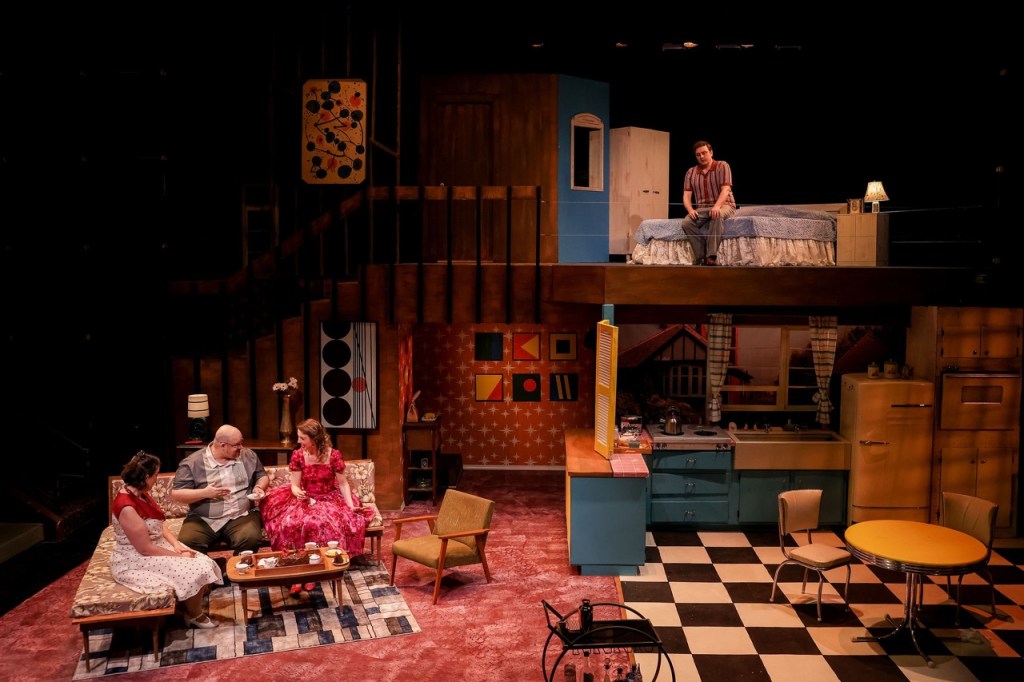
Home, I’m Darling, the Olivier Award–winning play for Best New Comedy (2019), makes its Twin Cities premiere at Lyric Arts in Anoka. It’s a wonder it took so long for a local company to stage it, it’s the perfect new work to engage audiences. Funny with commentary is such an intoxicating combination. It feeds both sides of our brains, entertaining us while also stimulating the parts of our brain that question things. The play will have you questioning the characters’ motivations as well as your own assumptions. I personally have always had an affinity for the pop culture trappings of the 1950s, more teen culture, early rock ’n’ roll, a malted and a burger, not the gender politics.
Johnny and Judy live an idyllic 1950s marriage, straight out of the movies and sitcoms of the time, but minus the kids and all their easily solved problems. The only discordant element is that it is, in fact, the 21st century, not the middle of the 20th. What began as a shared affinity for the aesthetic of 1950s nostalgia became an experiment to see if they could live their lives by the principles of that simpler time. Judy is a housewife; Johnny brings home the bacon, which he exchanges at the door for a much-deserved drink served by Judy before she finishes getting dinner on the table. They are surrounded by their carefully cultivated home, which resembles the movie set of a period remake of a Douglas Sirk film crossed with a 1950s malt shop.
The pair long for that simpler time, but there is no such thing, there never was, as Judy’s mother Sylvia points out in one of the play’s most thrilling scenes. What the characters fail to realize is that the world has moved on. Where it was once possible for the middle class to survive on one income, that hasn’t been the case for most households in a long time. The 1950s they have based their lives on comes from films and TV, not reality. The problems people have now, they had then, they just weren’t allowed to be shown in popular entertainment. When reality begins to seep in around the brightly colored walls of their fantasy, we begin to see whose fantasy it really is and how far they are willing to go to preserve it. There is a moment where I literally gasped out loud, and I wasn’t the only one.
Kyler Chase, who was the Noah Hynick of Lyric Arts (in seemingly every production) when I first started frequenting the theater, plays Johnny. He has the slightly forced 1950s spousal banter down perfectly but can switch into real-world mode when things hit the rocks. Kendra Mueller is incredible in portraying her character’s almost pathological need to be a 1950s housewife. She has that part of the role down perfectly; it is only topped by her ability to subtly project the fear she feels when cracks begin to appear. She looks the part, plays the part, becomes the part.
The supporting cast is quite good as well. Charlie Morgan and Siri Hellerman play their friends Fran and Marcus, who have a similar fondness for the 1950s but refrain from taking it as far as Johnny and Judy. Hellerman captures the awkwardness of a friend who tries to be supportive but struggles with the idea of abandoning her identity as a career woman. Morgan gets to show off some fancy footwork while also eventually revealing the darker side of the fantasy. Izzy Maxwell plays Johnny’s boss Alex, the modern career woman confronted, after being invited over for cocktails, with a previous century’s version of what some corners of society expected her to be. She’s excellent at trying to be respectful of Judy’s choice but is ill at ease with how to interact with her and their world. Patti Hynes-McCarthy plays Sylvia, Judy’s mother, and has a terrific scene where she unleashes on what she sees as a betrayal by her daughter of everything she fought for as a feminist. It’s a riviting scene and Hynes-McCarthy Absolutely nails it.
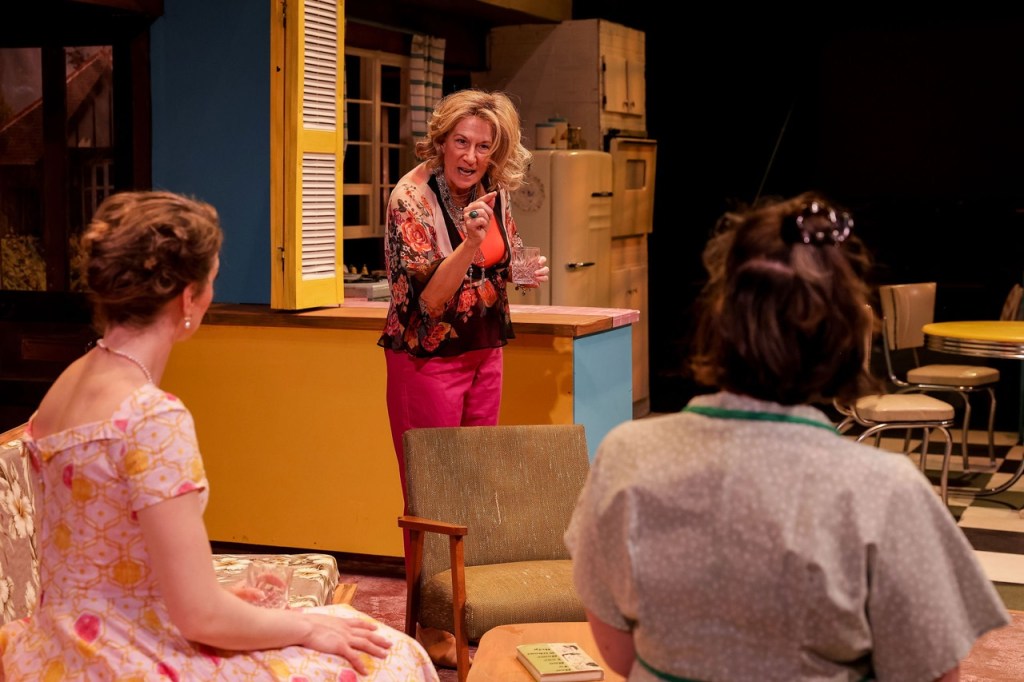
Scott Ford directs the show with inspired little flourishes during the scene changes that add to the artificial ’50s veneer. James Grace contributes to those and a few other scenes with fun choreography. Sarah Christenson’s costume designs and Greg Vanselow’s scenic design, along with Ren Edsen’s prop designs, are worth the price of a ticket on their own. It’s a great-looking show, and like the 1950s it emulates, there is a lot more happening than can be seen on the surface.
Home, I’m Darling runs through June 21st at Lyric Arts in Anoka. For more information and to purchase tickets, go to https://www.lyricarts.org/home-im-darling
The Stages of MN delivered straight to your inbox. It’s the best way to make sure you never miss out on the theater action. To subscribe on a computer, enter your email address on the home page (right-hand side) and click subscribe. On mobile, scroll to the bottom of the page to find the same option. You can also follow me on Facebook @thestagesofmn and on Instagram thestagesofmn.

The Stages of MN YouTube channel is home to the Stages of MN Show. You can watch it by clicking here. Be sure to check out the latest episodes and subscribe so you’ll always know when a new one drops. Not sure you agree with one of my takes? I’m also part of the Twin Cities Theater Bloggers (TCTB), where you can find review roundups from my colleagues and me. Follow us on Facebook at @TwinCitiesTheaterBloggers.


You must be logged in to post a comment.